
AI automation is moving quickly from simple task assistance to systems that can analyze information, make recommendations, trigger workflows, and sometimes take actions on their own. That shift is useful, but it also creates a common misunderstanding: automation does not automatically mean autonomy.
A system can process thousands of records, classify requests, generate responses, or detect suspicious activity without understanding the full business context behind its decisions. That is where human oversight becomes important. The real goal is not to keep people involved in every small task. It is to make sure people remain responsible for decisions where errors, ambiguity, security, or real-world consequences matter.
The need is becoming more visible as AI adoption accelerates. Stanford’s 2026 AI Index reports that organizational AI adoption reached 88%, showing how quickly AI is becoming part of everyday business operations.
Automation Can Move Fast. It Still Can’t See Everything.
Picture an AI application that manages customer service requests. This program is able to automatically receive and read new requests, identify recurring problems, search through its database, and prepare its replies in a matter of seconds.
Let’s take a customer whose message is, I was charged two times and please do not block my account since I need it for an important operation. The program is likely to detect a payment error but not to understand the second part correctly. Should it refund the payment? Should it escalate the situation? Should it block the account? Should it talk to the specialist?
AI is able to detect many patterns, but there are a lot of business decisions that are based on the data that is not presented in the available information.
NIST highlights this problem in its AI Risk Management Framework, noting that converting complex human and social situations into data can remove important context. It also recommends clearly defining human responsibilities in AI decision-making and oversight.
That distinction matters. An automated process can be highly efficient while still requiring human judgment at critical points.
The Bigger Risk Is Not AI Making Every Decision
The more practical concern is allowing AI to make an important decision without anyone knowing when it is wrong.
Consider an automated financial workflow. An AI system could detect unusual spending, categorize transactions, and flag potential fraud. Those are useful tasks because they involve large amounts of repetitive data.
But automatically blocking a legitimate transaction is different.A person may recognize that the transaction matches a seasonal purchase, a new supplier, or an unusual but approved business activity. Without that context, an AI system could turn a useful security control into a costly disruption.
The same principle applies to software security. In discussions around SBOM & CVE in Software Security, automation can help identify vulnerable components and connect security findings to affected applications.
But deciding whether a vulnerability is truly urgent still requires context such as exploitability, business exposure, data sensitivity, and compensating controls.
This is why oversight should not be treated as a backup plan. It should be part of the workflow itself.
Why AI Systems Can Produce Confidently Wrong Results
One of the main issues that confront us while working with modern AI pertains to its tendency to produce results that do not reveal that they are wrong. Whereas conventional software might have malfunctioned, giving an error message, an AI system produces plausible results, appropriately formulated, and wrong.
This situation gives rise to a danger of what is called automation bias, when people tend to trust automated recommendations just because they were produced by an advanced system. NIST points out that interactions between humans and AI are unpredictable, and AI can amplify human biases instead of eliminating them.
An AI recruitment system might rank candidates according to the historical patterns of hiring, so if these patterns are biased, the system will reproduce the bias at scale. However, the human reviewer could challenge the recommendation, understand the rationale behind it, and identify the problem that AI fails to recognize.
The crucial thing is that human input cannot be trusted due to the fact that humans are more accurate. Humans can also make mistakes; however, cooperation is useful because both humans and AI have their own weaknesses.
Not Every Task Needs the Same Level of Oversight
Human oversight does not mean someone needs to approve every automated action. That approach would remove much of the value of automation. A better model is risk-based oversight. Low-risk, repetitive activities can operate with minimal intervention. High-impact decisions should have stronger controls.
For example:
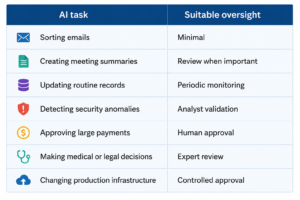
NIST makes a similar distinction: some AI applications may not require direct human oversight, while others specifically need it depending on their context and potential impact.
The question should therefore not be, Can AI do this without a human? The better question is, What happens if AI gets this wrong? That changes how organizations design automation.
Oversight Must Happen Before, During, and After Automation
Human oversight is often misunderstood as a final approval button. In practice, meaningful oversight starts much earlier. Before deployment, people need to define what the AI is allowed to do, what data it can access, and what decisions it must never make independently.
During operation, teams need visibility into what the system is doing. That can include logs, alerts, confidence thresholds, approval checkpoints, and monitoring for unusual behavior.
After deployment, organizations need to examine incidents, false positives, user feedback, and changes in system performance. NIST’s AI RMF specifically calls for documented human-oversight processes and clearly defined roles and responsibilities across AI systems.
This is especially important for AI agents that can interact with other systems. An agent that only generates a suggestion is one thing. An agent that can send emails, modify records, execute code, or access business applications has a much larger risk surface.
AI Security Makes the Oversight Problem Even More Important
The consequences of weak AI oversight are already measurable. IBM’s 2025 Cost of a Data Breach research found that 13% of organizations reported breaches involving AI models or applications. Among those organizations, 97% reported a lack of proper AI access controls. The study also found that 63% of breached organizations either lacked an AI governance policy or were still developing one.
India shows a similar gap. IBM reported that only 37% of organizations surveyed in India had AI access controls, while nearly 60% either lacked AI governance policies or were still developing them. The average cost of a data breach in India reached ₹220 million in 2025.
These numbers show why AI automation cannot be treated as only a productivity project. Access permissions, data handling, security monitoring, and human accountability all become part of the automation design.
Interestingly, the same IBM research found that organizations using AI and automation extensively in security operations reduced breach costs by an average of $1.9 million.
So the answer is not to reduce automation. It is to automate the right things while maintaining control over the things that matter most.
Human-in-the-Loop Should Mean More Than Clicking Approve
An example of a basic oversight model is when AI decides, and a human immediately shows his consent. With this level of oversight, even if the AI decision is flawed, the responsibility is nevertheless transferred to the human without providing him with sufficient information and time to contest the decision.
In order to be effective, oversight needs to be informed.
This means that a financial expert should grasp the reasons WHY a particular transaction has been flagged. A security expert should understand the rationale for classifying a specific event as suspicious. A manager reviewing a report produced by AI must also be able to backtrack any crucial number.
Moreover, a human should have the power to reject the AI’s suggestion.
Research published in AI and Ethics in 2026 warns that human oversight can become little more than a rubber stamp when it is poorly designed. The study emphasizes creating oversight mechanisms that preserve meaningful human agency rather than simply adding a person to the process.
That is a crucial distinction. The human should not exist to validate the machine. The human should exist to challenge it when necessary.
What Good AI Oversight Looks Like in Practice
Any effective AI automation strategy is built on some basic principles. To begin with, it is important to set clear boundaries. AI must understand its sources of data, actions, and where approval is required.
Escalation rules must also be taken into consideration: if there is a low level of confidence, the information is contradictory, or the decision is a significant one, then the process must be performed by an individual.
Audit trail is also essential due to the need of being aware of what the system received, produced, performed, and who approved the outcome. Furthermore, the performance should be monitored over time as well. For instance, the AI work strategy that used to be efficient half a year ago might not be effective anymore due to changed data, models or business conditions.
The Future Is Controlled Autonomy, Not Zero Human Involvement
The capability of AI is not going to stop growing. The trend is for businesses to further automate work processes and more AI agents will be able to perform various tasks across different software systems. That should not be interpreted as creating a possibility of eliminating human involvement. It will change the type of human role in the process, however.
The future holds less time spent on routine transactions and much more on exceptions, limits, anomalies, and complicated decisions. This is the way AI technology should evolve.
The most effective systems would not be those which do less work with people. Rather, they would be systems which understand when human input is necessary and who provide an easy way for us to do so.
AI is well suited to handle speed, scalability, patterns, and repetitions. Humans on the other hand are still needed for context, accountability, judgment, and responsibilities.
This means that the future of the AI industry should not be about getting rid of humans in process as much as about creating smarter processes.
Conclusion
AI automation can enhance the speed and reliability of business processes and enable easier scaling, but speed should not outweigh the need for control. Although AI can interpret data and perform repetitive tasks, it still may overlook certain aspects, give incorrect outputs, or take actions with unforeseen effects. Therefore, it is necessary to involve human judgement.
The idea is to prevent slowing down automation by performing human checks on each step of the process, but to outline certain boundaries and watch over important decision-making processes and involve people in the process when there are increased risks or unpredictability involved.