Preparing for a certification exam is already an exercise in prioritisation. During an exam transition, it becomes an information-management problem too. A candidate can find two apparently credible pages that recommend different study materials, different domain priorities, or different timelines. Both pages may have been accurate when written. Only one may apply to the candidate’s scheduled exam.
That is the trap in 2026 for candidates preparing for the Certified Information Security Manager (CISM) exam. ISACA has confirmed that the CISM Exam Content Outline will change effective 3 November 2026. It has also said that updated official preparation materials will be available for purchase in September 2026. Those are related dates, but they do not mean the same thing.
The safest response is not to chase every new headline or rebuild a study plan each time a post appears. It is to verify each important claim through a short evidence chain: identify the claim, find the source owner, check the version and effective date, test whether it applies to your appointment, and record the action that follows.
Key takeaways
- Your scheduled exam date, not the date on which you read an article, determines which exam outline applies.
- Separate claims about exam content from claims about registration, eligibility, scheduling, and commercial study products.
- Use ISACA’s own credential and exam-outline pages as the authority for CISM rules and content.
- Treat summaries, videos, forums, and training-provider pages as navigation or interpretation, not as the final source of truth.
- Change your study plan only when a verified fact produces a specific consequence for your exam date or materials.
Why exam-transition advice becomes confusing
Most misinformation during an exam update is not a completely invented claim. It is a real fact with missing context.
For example, “the CISM exam changes in 2026” is broadly true but operationally incomplete. A candidate testing on 30 October and a candidate testing on 10 November are preparing in the same calendar year, yet ISACA’s stated effective date places them on different sides of the transition.
Other statements create the same problem:
- “New materials arrive in September” does not mean the updated outline is tested in September.
- “The outline is changing” does not mean current materials become useless before the effective date.
- “This course has been updated” does not establish which version it covers unless the provider identifies the applicable outline.
- “The domains have changed” is not enough to justify reallocating study time without a source-backed comparison.
Candidates therefore need more than a list of trusted websites. They need a method that tests whether a particular statement is authoritative, current, and applicable.
Start with the facts ISACA has actually confirmed
The current ISACA CISM Exam Content Outline states that the exam contains 150 questions across four job-practice domains. The same page carries an update notice: the new outline becomes effective on 3 November 2026, and updated preparation materials will be available for purchase in September 2026.
ISACA’s CISM certification page repeats the transition date and adds an important commercial detail: purchasing current ISACA preparation material does not grant access to the newer material later.
These statements support a clear decision rule:
- If your exam is before 3 November 2026, the current outline applies.
- If your exam is on or after 3 November 2026, the updated outline applies.
- If your appointment moves across that boundary, your preparation basis may need to change.
Notice what these sources do not yet justify. They do not support an assumed domain-by-domain comparison merely because somebody has published one. They do not prove that a third-party question bank has been remapped. They do not establish that a candidate should stop studying while waiting for new materials. Those conclusions require their own evidence.
The five-check CISM source test
Use the following checks for any claim that could change what you study, buy, book, or believe about the credential.
1. Define the exact claim
Do not verify a topic; verify a sentence.
“CISM is changing” is too vague. “The updated CISM outline applies to exams taken from 3 November 2026” is testable. So is “updated official preparation materials will be available in September 2026.”
Classify the claim before you search for evidence:
- Exam-content claim: domains, task statements, weights, question format, or effective date.
- Exam-administration claim: registration, scheduling, remote proctoring, identification, rescheduling, or fees.
- Certification claim: experience requirements, application window, ethics, or continuing education.
- Study-product claim: which outline a book, course, question bank, or practice platform covers.
This classification prevents a common category error. An official page about exam content may not answer a scheduling question. ISACA can confirm the governing outline, but only a study provider can accurately state which version its own product currently supports.
2. Identify who owns the fact
Ask which organisation has the authority to make or change the statement.
ISACA owns the CISM credential, its exam content outline, and its certification requirements. Its credential pages, exam candidate guidance, support notices, and store descriptions are therefore the first-party sources for those facts.
A training provider owns facts about its own course: the edition, update date, access period, refund terms, and outline mapping. It does not own the exam rules. A discussion forum may help a candidate interpret a difficult concept, but it cannot establish an effective date. A search-result snippet may expose a relevant phrase, but it is not the page itself and may omit the qualifying sentence.
A useful source hierarchy is:
- Credential owner: the current policy, outline, guide, or support notice.
- Product owner: the documentation for claims about that product.
- Maintained independent summary: a page that links to the first-party evidence.
- Commentary: community discussion, videos, and undated study notes.
Lower levels can be useful, but they should lead you upward before you make a consequential decision.
3. Check the version, effective date, and retrieval date
A trustworthy page can still be the wrong version.
Look for an explicit effective date, edition number, “last updated” date, or version label. Then distinguish three moments:
- Announcement date: when the change became public.
- Material-release date: when updated books, courses, or practice tools become available.
- Exam-effective date: when the changed outline is actually tested.
For the 2026 CISM transition, September is the stated release month for updated official preparation material; 3 November is the exam-outline effective date. Collapsing those dates into “the exam changes in September” creates a false conclusion from two true facts.
Record when you checked the source as well. A note that says “verified on 5 August 2026” is more useful than a bookmark with no context, particularly if you will make a purchase or sit the exam months later.
4. Test applicability against your own appointment
The decisive question is not “Is this page current?” It is “Does this fact apply to my scheduled exam?”
Consider two candidates who read the same announcement on the same day:
- Candidate A is booked for 29 October 2026. The current outline remains the relevant study basis, provided the appointment stays before 3 November.
- Candidate B is booked for 12 November 2026. The updated outline applies, so this candidate should use the new official outline and materials when ISACA publishes them.
Now imagine Candidate A reschedules to 6 November. The source did not change, but its applicability did. That is why the exam date belongs in the evidence record.
If your date is not yet booked, avoid pretending that one version definitely applies. Plan around the likely window, note the transition risk, and confirm the actual appointment before making an irreversible purchase.
5. Translate evidence into a bounded action
Verification is useful only when it changes a decision.
For each confirmed claim, write one action and one non-action. For example:
- Confirmed fact: the updated outline applies from 3 November 2026.
- Action: if my appointment is on or after that date, compare my plan with the updated official outline when it is released.
- Non-action: do not assume an unofficial domain comparison is correct before checking it against ISACA.
Or:
- Confirmed fact: updated official preparation materials are scheduled for September 2026.
- Action: review the new edition and access terms before buying for a post-transition exam.
- Non-action: do not infer that September publication changes an October exam.
The non-action matters because transition anxiety often produces unnecessary work: abandoning valid notes, buying duplicate resources, or changing an exam date without evidence that the current plan is unsuitable.
Build a one-page evidence record
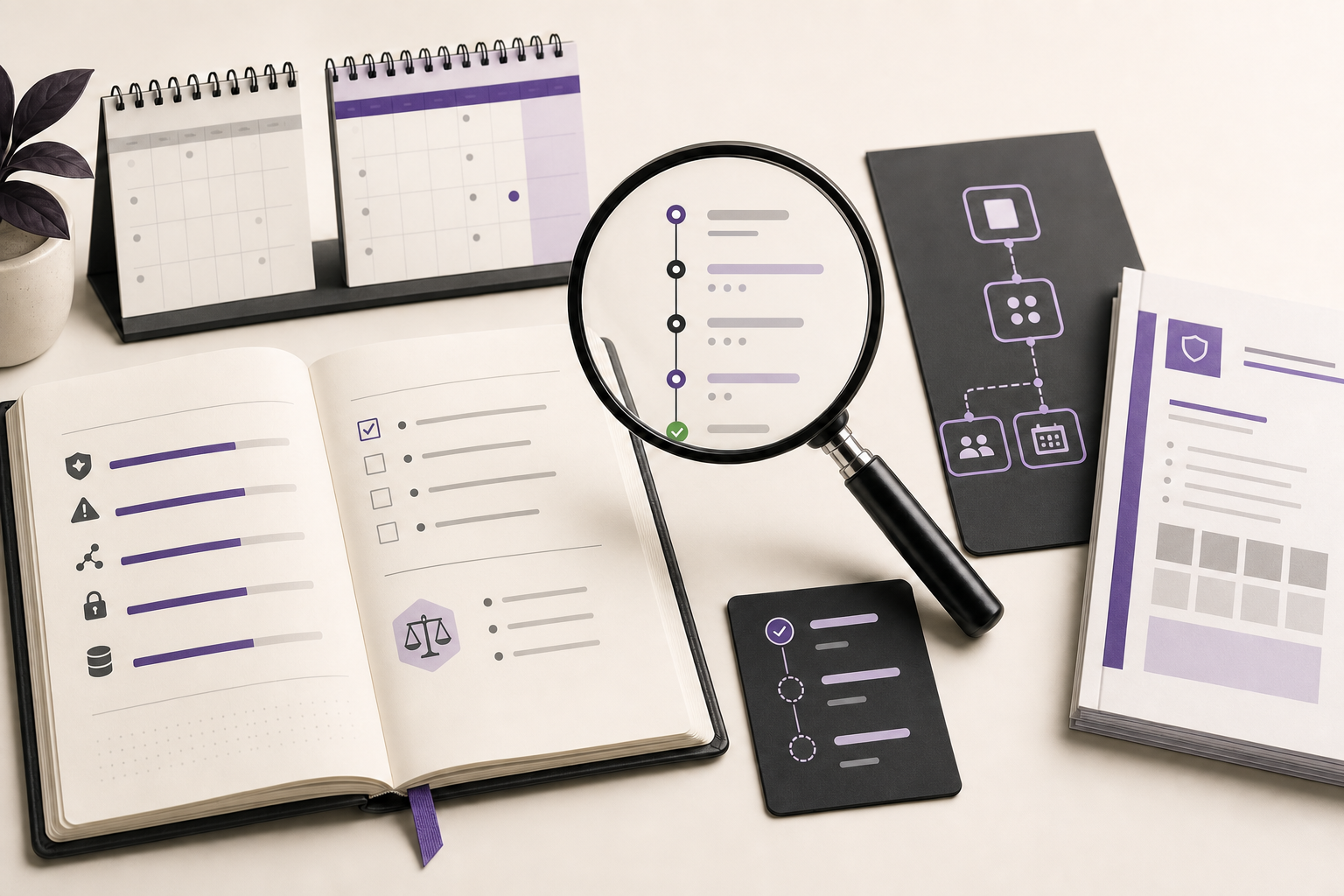
You do not need a research database. A small table is enough:
| Claim | Evidence record | Applies to my exam? | Action |
|---|---|---|---|
| Updated outline begins | ISACA CISM outline; effective 3 November 2026; checked 5 August 2026 | Yes, if exam is on or after the date | Re-map the plan after the official outline is available |
| New official materials | ISACA CISM credential page; September 2026 availability; checked 5 August 2026 | Relevant to a post-transition exam | Check edition and access terms before purchase |
| Third-party question bank is updated | Provider’s own release notes; version must be stated; not yet verified | Unknown | Do not rely on the claim yet |
This record exposes gaps quickly. If the “source” cell contains only a screenshot, social post, search snippet, or forum comment, the claim is not ready to drive a decision. If the effective-date cell is blank, you may be looking at accurate but unusable information.
It also gives you a clean way to reassess. When a source changes, update the relevant row rather than rebuilding your entire study plan from memory.
Use independent summaries as maps, not authorities
A well-maintained secondary page can save time by gathering official links and translating them into a decision rule. It should make its relationship to the credential owner clear, show when it was reviewed, and avoid claiming more than the primary sources support.
For example, the CertArc CISM 2026 exam-update tracker separates exams before 3 November from those on or after the date, links back to ISACA, and states that it will not publish a domain-by-domain or product-coverage claim before verifying the updated official material. That makes it useful as a navigation aid. The operative facts should still be rechecked on ISACA before you buy materials or change an appointment.
This is the right role for any independent summary: reduce search friction, preserve context, and lead the reader to the authority. If a secondary page hides its sources, has no verification date, or converts an announced change into an unsupported product claim, do not let it determine your plan.
Recheck at decision points, not every day
Constant monitoring adds stress without necessarily improving accuracy. Reverify when a fact could change an action:
- Before buying a time-limited course, book, or question-bank subscription.
- When ISACA releases the updated outline or preparation materials.
- When you book, reschedule, or cancel an exam appointment.
- Two weeks before the exam, so there is time to resolve a discrepancy.
- When a provider announces that its product has moved to a new outline.
Use the same source pages each time. This makes a real change visible and protects you from reacting to recycled articles that merely carry a new publication date.
What a defensible study decision looks like
A defensible decision is not necessarily the most cautious or expensive option. It is one that can be traced from evidence to action.
Suppose you plan to test in late October. You confirm the appointment, verify the 3 November effective date on ISACA, and continue using current-outline materials. You also note that a reschedule beyond the transition would require a new review. That is reasonable.
Suppose instead that you plan to test in mid-November. You keep studying transferable management concepts now, wait for the official updated outline before reallocating domain effort, and check whether each paid resource identifies its supported version. That is also reasonable.
What is not defensible is changing course because an undated page says “new CISM exam,” or assuming that a current resource covers an unreleased outline because its marketing copy says “2026.”
The point of source verification is not to eliminate uncertainty. It is to keep uncertainty visible, bounded, and attached to a review trigger.
Verify first, then adapt
Exam updates do not require candidates to distrust every resource. They require candidates to separate authority, version, and applicability.
Start with a precise claim. Find the organisation that owns it. Check the effective date and version. Compare it with your real appointment. Record the action that follows, along with the condition that would make you revisit it.
That five-check habit is useful beyond the 2026 CISM transition. Certification rules, product editions, testing policies, and schedules will continue to change. Candidates who can trace a claim to its owner and decide whether it applies will spend less time reacting to noise and more time preparing against the right target.
Author bio

Swaminadhan Jagadeesan | Technical Content Writer at CertArc
Swaminadhan Jagadeesan is a Technical Content Writer at CertArc and a CISM, AAISM, and PMP-certified practitioner. He writes evidence-led guidance on cybersecurity governance, certification preparation, technology risk, and responsible AI, with a focus on turning complex source material into practical decisions.
Disclosure
The author is affiliated with CertArc. CertArc is not affiliated with, endorsed by, or sponsored by ISACA. CISM is a registered trademark of ISACA.