Cybersecurity teams are facing a growing volume of security alerts, increasingly complex digital environments, and threats that can evolve quickly. At the same time, organizations are generating more security data than human analysts can reasonably review manually. Artificial intelligence (AI) is becoming an important tool for helping security teams analyze this information, identify suspicious activity, and respond more efficiently.
AI does not replace cybersecurity professionals. Instead, its greatest value comes from supporting human analysts with faster analysis, pattern recognition, prioritization, and repetitive tasks. NIST’s work on the intersection of AI and cybersecurity similarly recognizes both sides of the equation: AI can strengthen defensive capabilities while also introducing new cybersecurity risks that organizations need to manage.
Understanding the Role of AI in Cybersecurity
Traditional cybersecurity workflows often depend on predefined rules, signatures, alerts, and manual investigation. These methods remain important, but modern environments can produce enormous numbers of events across endpoints, networks, cloud services, applications, and identity systems.
AI can help process these signals at scale. Machine learning models can identify patterns in data, while newer AI systems can assist analysts with tasks such as summarizing alerts, correlating information, and organizing investigation findings.
The goal is not to allow AI to make every security decision independently. Instead, organizations can use AI to reduce repetitive work and help security professionals concentrate on higher-value investigations and decisions.
- Faster Threat Detection
One of the most important applications of AI is detecting unusual behavior.
A security environment may generate thousands or millions of events. Reviewing every event manually is impractical. AI-based systems can analyze large datasets and identify activity that differs from established patterns.
For example, an organization might monitor:
- Unusual login behavior
- Unexpected access to sensitive resources
- Sudden changes in network traffic
- Abnormal application activity
- Repeated failed authentication attempts
- Unusual activity across cloud environments
This type of analysis can help security teams prioritize events that deserve closer investigation.
NIST describes continuous monitoring and anomaly detection as important parts of cybersecurity detection activities, making AI-assisted analysis a natural complement to existing security processes.
- Better Alert Prioritization
Security teams often struggle with alert overload. Not every alert represents a serious security incident, and investigating low-priority events can consume valuable analyst time.
AI can help prioritize alerts by examining multiple signals together rather than treating every event independently.
For example, an isolated failed login might not be particularly concerning. However, repeated failed logins followed by an unusual successful login and access to a sensitive system could deserve much more attention.
By correlating related events, AI can help analysts understand which alerts may represent a broader pattern.
This does not mean that an AI-generated priority should automatically be treated as fact. Analysts should still have the ability to review the evidence behind important decisions.
- Supporting Security Investigations
Cybersecurity investigations frequently require analysts to examine information from multiple sources.
An investigation might involve:
- Authentication logs
- Endpoint activity
- Network events
- Cloud records
- Application logs
- Threat intelligence
- Previous security incidents
AI can assist by organizing and summarizing this information. Instead of manually reviewing every piece of data, analysts can use AI-assisted tools to identify connections and create an initial overview of an incident.
This can shorten the time needed to understand what happened and allow security professionals to spend more time validating evidence and determining the appropriate response.
- Improving Incident Response
Detection is only one part of cybersecurity. Organizations also need effective processes for responding to incidents.
NIST’s current incident-response guidance emphasizes integrating incident response throughout cybersecurity risk management and improving the efficiency of detection, response, and recovery activities.
AI can support these processes by helping teams:
- Summarize an incident
- Organize relevant evidence
- Suggest investigation steps
- Identify related alerts
- Draft incident reports
- Track response activities
- Compare an event with previous incidents
For high-impact actions, human approval remains important. Automatically taking a disruptive action based on an incorrect AI conclusion could create additional problems.
5. Helping Security Teams Handle Large-Scale Data
Modern organizations operate across increasingly distributed environments. Security information can come from on-premises infrastructure, cloud platforms, remote devices, applications, and third-party services.
AI can process large volumes of structured and unstructured information much faster than a person working manually.
This can be particularly useful when security teams need to identify relationships between events that may appear unrelated at first.
However, organizations should remember that AI output is only as reliable as the data, systems, and processes supporting it. Poor-quality or incomplete data can lead to inaccurate conclusions.
6. AI Can Also Create New Cybersecurity Risks
AI is not only a defensive technology. Organizations must also secure the AI systems they deploy.
NIST’s Cyber AI Profile identifies three important areas: securing AI system components, using AI for cyber defense, and addressing AI-enabled cyber attacks.
AI systems can introduce risks involving:
- Sensitive data exposure
- Unauthorized access
- Manipulated inputs
- Model vulnerabilities
- Data poisoning
- Privacy concerns
- Incorrect or misleading outputs
NIST’s AI Risk Management Framework also highlights security, resilience, privacy, transparency, explainability, and accountability as important characteristics of trustworthy AI.
For this reason, organizations should treat AI security as part of their overall cybersecurity strategy rather than as a separate technical experiment.
7. Keeping Humans in the Loop
One of the most important principles for AI-assisted cybersecurity is maintaining appropriate human oversight.
AI can analyze information quickly, but cybersecurity decisions often require context. A security analyst may know about a business process, planned system change, or unusual but legitimate activity that an automated system cannot understand.
A practical workflow can therefore divide responsibilities:
AI handles:
Data analysis, pattern recognition, alert grouping, summarization, and repetitive tasks.
Security professionals handle:
Validation, investigation, risk assessment, major decisions, and final response actions.
This approach allows organizations to benefit from automation without removing human judgment from critical security decisions.
8. Building a Safer AI-Assisted Security Workflow
Organizations considering AI for cybersecurity should start with clearly defined problems rather than adopting AI simply because it is popular.
A practical approach includes:
Define the use case
Determine exactly what AI is expected to improve. Examples include alert prioritization, log analysis, investigation support, or reporting.
Establish data controls
Identify what information the AI system can access. Sensitive security and personal data should be handled according to appropriate privacy and security requirements.
Test before deployment
AI systems should be evaluated using realistic scenarios before they are trusted in important workflows.
Monitor performance
Organizations should regularly check whether AI outputs remain accurate and useful as systems, threats, and data change.
Maintain human oversight
High-impact security actions should have appropriate review and approval mechanisms.
Prepare for failure
Security teams should know what happens if an AI system becomes unavailable, produces incorrect results, or behaves unexpectedly.
These practices align with the broader risk-management approach promoted by NIST for trustworthy and secure AI.
The Future of AI in Cybersecurity
AI is likely to become increasingly integrated into cybersecurity operations. Security teams may use AI not only for detecting suspicious activity but also for investigation, threat analysis, documentation, and workflow automation.
At the same time, organizations will need to adapt their security practices as AI capabilities develop. NIST’s Cyber AI Profile work reflects this changing landscape by considering both cybersecurity risks associated with AI and opportunities to use AI for stronger cyber defense.
The most effective approach will not be to automate everything. Instead, organizations should combine AI’s ability to process information at scale with the experience, judgment, and accountability of cybersecurity professionals.
Conclusion
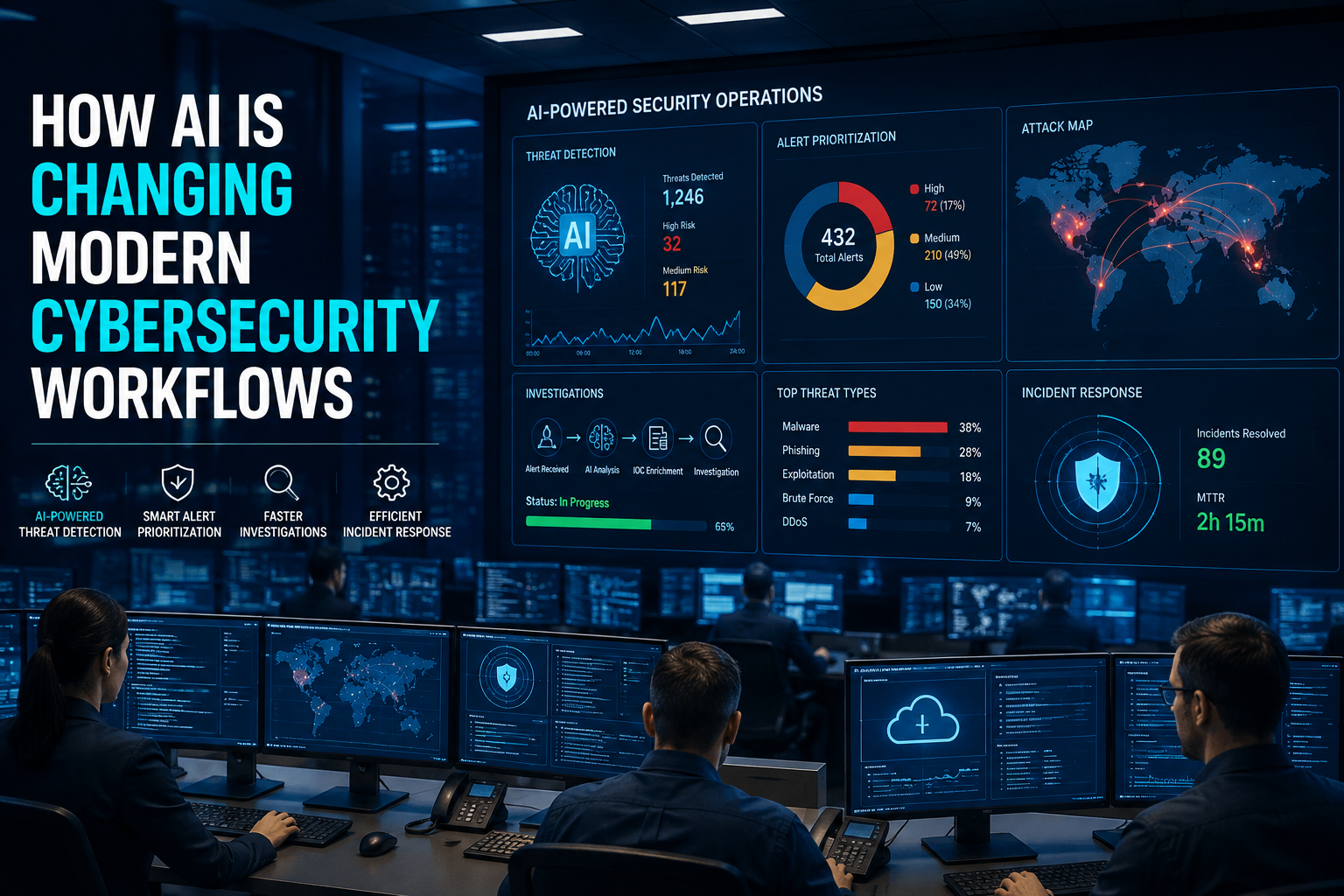
AI is changing modern cybersecurity workflows by helping teams analyze large volumes of information, detect unusual activity, prioritize alerts, support investigations, and improve incident-response processes.
However, AI should be viewed as a powerful support tool rather than a replacement for security professionals. Organizations must also address the risks associated with AI systems themselves, including data protection, model security, reliability, privacy, and human oversight.
When implemented thoughtfully, AI can make cybersecurity workflows faster and more manageable while allowing security professionals to focus on the decisions that require human expertise. The key is to combine automation with strong security practices, continuous monitoring, and responsible human oversight.
Sources
- National Institute of Standards and Technology (NIST), Cybersecurity Framework Profile for Artificial Intelligence (Cyber AI Profile).
- National Institute of Standards and Technology (NIST), AI Risk Management Framework.
- National Institute of Standards and Technology (NIST), Incident Response Recommendations and Considerations for Cybersecurity Risk Management.
- National Institute of Standards and Technology (NIST), Trustworthy and Responsible AI.