
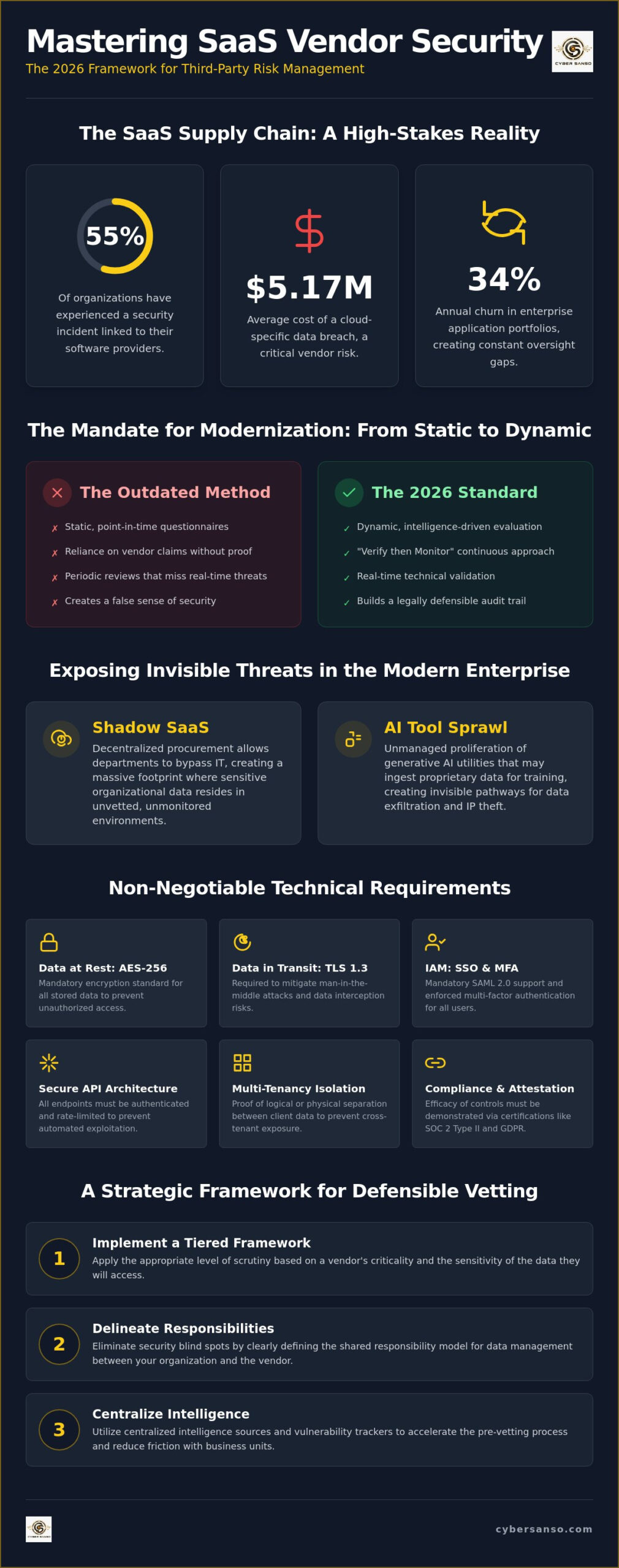
55% of organizations have already experienced a security incident linked to their software providers, yet the average enterprise continues to manage a 34% annual churn rate in its application portfolio. This constant turnover creates a significant gap between rapid tool adoption and necessary oversight. Performing a rigorous SaaS vendor security assessment is no longer just a compliance checkbox; it’s a critical defense against the $5.17 million average cost of a cloud-specific data breach. You’re likely struggling to verify vendor claims while facing internal pressure to approve new tools quickly.
This article provides a strategic framework to help you master the technical and operational rigor required to evaluate vendors in a complex digital ecosystem. We’ll detail how to move beyond static checklists toward a dynamic, intelligence-driven evaluation process. We’ll examine essential 2026 standards, such as TLS 1.2 or higher for data in transit and SOC 2 Type II efficacy, while ensuring compliance with global mandates like GDPR. By following this guide, you’ll establish a repeatable, defensible method to reduce third-party risk and maintain organizational integrity.
Key Takeaways
- Transition from static, point-in-time checklists to a dynamic evaluation model that reflects the high-velocity 2026 threat landscape.
- Implement a tiered SaaS vendor security assessment framework to apply the appropriate level of scrutiny based on vendor criticality and data access.
- Define non-negotiable technical requirements for data protection, specifically mandating AES-256 encryption at rest and TLS 1.3 for transit.
- Eliminate security blind spots by clearly delineating responsibilities between the vendor’s infrastructure and your organization’s data management.
- Utilize centralized intelligence sources and vulnerability trackers to accelerate the pre-vetting process and reduce friction with business units.
The Evolution of SaaS Risk and the Necessity of Rigorous Assessment
The traditional enterprise perimeter has effectively vanished. Modern infrastructure is now a sprawling ecosystem of interconnected cloud services where security is only as robust as the weakest link in the chain. In 2026, the SaaS vendor security assessment has become the most critical tool for maintaining organizational integrity. High-velocity adoption cycles mean that business units integrate new applications at a pace that often outstrips traditional security reviews. This environment creates a massive supply chain threat. A compromise at a single niche provider can trigger a cascading failure across thousands of downstream clients. It effectively turns a minor software utility into a high-value entry point for sophisticated threat actors.
Documented due diligence is now a legal mandate rather than a suggestion. SEC reporting requirements, GDPR enforcement, and specific industry regulations require a transparent, verifiable audit trail of how vendors are selected and managed. Professional third-party risk management has moved beyond the era of periodic, static questionnaires. It now requires a “verify then monitor” approach. This standard is characterized by continuous technical validation and real-time oversight rather than point-in-time trust. Organizations that fail to adapt to this model face significant exposure during regulatory audits and post-incident investigations.
The Hidden Danger of Shadow SaaS and AI Sprawl
Decentralized procurement allows departments to bypass IT, creating a massive “Shadow IT” footprint where sensitive data resides in unvetted environments. Many of these tools now include integrated Large Language Models (LLMs) that may ingest proprietary data for training purposes without explicit consent. AI Tool Sprawl is the unmanaged proliferation of generative AI utilities within an organization. Without a formal SaaS vendor security assessment, these utilities operate outside the standard security stack. They create invisible pathways for data exfiltration and intellectual property theft that traditional firewalls cannot detect.
Case Studies in Third-Party Failures
Historical breaches like SolarWinds and Kaseya highlight the catastrophic danger of inherent trust in software supply chains. Attackers compromised the update mechanisms of these trusted providers to distribute malicious code to a global user base. Many cloud-based incidents originate from misconfigured environments, which usually occur because the customer misunderstood their role in the shared responsibility model. The financial cost of these failures is often staggering, but it’s secondary to the long-term reputational damage. Performing adequate vendor due diligence is the only reliable method to identify these systemic vulnerabilities before they are exploited.
Core Domains of a Comprehensive SaaS Security Evaluation
A rigorous SaaS vendor security assessment requires a granular examination of technical and operational controls. Organizations must move beyond superficial checks to ensure that a vendor’s architecture can withstand modern attack vectors. This begins with baseline encryption standards. Data at rest must be secured using AES-256, while data in transit requires TLS 1.3 to mitigate interception risks. Identity and Access Management (IAM) is equally vital. Support for Single Sign-On (SSO) and SAML 2.0 is mandatory for enterprise-grade tools, as is the enforcement of multi-factor authentication (MFA) for all administrative and user-level access.
Infrastructure security must also focus on multi-tenancy isolation. If a vendor can’t demonstrate logical or physical separation between client data, the risk of cross-tenant exposure increases significantly. For those looking to standardize their intake, utilizing Vendor Security Alliance questionnaires provides a structured foundation for gathering this evidence. Secure API architecture also demands scrutiny, ensuring that all endpoints are authenticated and rate-limited to prevent automated exploitation.
Vetting AI and LLM Security Controls
As SaaS providers integrate generative AI, the assessment must cover data residency and model training policies. You need to know if your proprietary data is used to train the vendor’s underlying models. Additionally, evaluate their defenses against prompt injection and the presence of robust output filtering mechanisms. A formal AI Ethics and Security policy should be a prerequisite for any tool processing sensitive information.
Compliance and Third-Party Attestations
Attestations provide a hierarchy of trust, but they’re not created equal. A SOC 2 Type II report, which covers a 6 to 12 month observation period, is superior to a point-in-time ISO 27001 certification. While a SOC 3 report is useful for public marketing, it lacks the technical detail required for a deep security audit. Always remember that a vendor’s compliance with a regulatory framework does not always equal actual security in practice. Security leaders selecting automation platforms to support their audit readiness should consult a rigorous SOC2 compliance tool comparison to identify solutions that meet actual auditor acceptance standards. For a more comprehensive view of the market, you can browse a Cybersecurity Vendor Database to compare verified listings.
Operational and Financial Stability
A vendor’s financial health is an often overlooked security risk. Sudden service termination due to insolvency can lead to data loss or unmanaged exposure. Review the vendor’s incident response history and transparency regarding past disclosures. Service Level Agreements (SLAs) must be scrutinized not just for general uptime, but for specific security-related windows, such as breach notification timelines and the frequency of disaster recovery (DR) testing.
A Step-by-Step Execution Framework for Vendor Risk Management
Executing a structured SaaS vendor security assessment requires a phased approach that balances technical scrutiny with operational efficiency. Organizations must move away from treating all software providers as equal risks. Instead, a defensible framework prioritizes resources toward vendors with the highest potential impact on the data supply chain. This process begins with discovery and ends with long-term lifecycle management, ensuring that security posture doesn’t degrade after the initial contract is signed.
Tiering Your Vendor Portfolio
Effective risk management begins with classification. You must categorize vendors based on the sensitivity of the data they process and their level of integration with your core systems. A “Critical” vendor handles personally identifiable information (PII) or financial data; a “Low Risk” vendor might only manage public-facing marketing assets. Customizing the assessment depth according to these tiers prevents bottlenecks and allows security teams to focus on high-stakes evaluations. Most mature organizations utilize a risk-scoring matrix to standardize these internal decisions and provide clear justifications for approval or rejection.
Phase 2 involves technical evidence collection. This stage moves beyond the static questionnaire to request actual artifacts, such as recent penetration test executive summaries or SOC 2 Type II reports. Following this, Phase 3 requires a deep-dive technical review of the “Shared Responsibility Model.” You must explicitly define which security controls are the vendor’s obligation and which remain your responsibility. If gaps are identified, Phase 4 focuses on risk remediation. This is the period where you negotiate security improvements or contractual addendums before the final agreement is executed.
The Security Questionnaire: Best Practices
Questionnaires serve as the baseline for any SaaS vendor security assessment, but they are only as effective as the questions asked. Utilizing industry standards like the CAIQ (Consensus Assessments Initiative Questionnaire) ensures a comprehensive review of cloud-specific controls. Security analysts should look for “red flag” answers, such as vague descriptions of encryption practices or a lack of formal incident response timelines. It’s vital to demand raw evidence rather than accepting simple “yes” or “no” responses. Verifiable proof of control implementation is the only way to validate a vendor’s security claims accurately.
The final phase is continuous monitoring. A vendor’s risk profile is not static. It changes with every software update, new sub-processor, or discovered vulnerability. Transitioning from a one-time assessment to ongoing lifecycle management involves periodic reviews and real-time threat tracking. By maintaining this rhythmic oversight, you ensure that the vendor remains a secure partner throughout the duration of the business relationship.
Addressing the Shared Responsibility Gap
Security in a SaaS model is never a monolithic obligation; it is a partitioned responsibility. The vendor manages the physical security of data centers and the underlying host operating systems, while the customer retains control over user access, data classification, and application-level settings. A thorough SaaS vendor security assessment must explicitly map these boundaries to prevent operational blind spots. Failure to document these “hand-off” points often results in critical tasks, such as log monitoring or patch management for integrated third-party apps, falling through the cracks. Documenting these points requires a RACI matrix that details who manages encryption keys and who is responsible for the security of API-connected services.
A common error is the belief that a vendor’s high-level certification, such as a SOC 2 report, absolves the customer of technical oversight. While the provider ensures the infrastructure is resilient, they can’t prevent an administrator from over-provisioning user permissions or disabling multi-factor authentication (MFA). You must actively manage the security of the data you place within the tool. This includes the regular auditing of API integrations, which often serve as invisible gateways for data exfiltration if they aren’t properly scoped and authenticated.
Configuration Drift and the Need for SSPM
SaaS Security Posture Management (SSPM) tools provide the continuous oversight necessary to detect when a vendor’s default settings are altered, creating a real-time defense against configuration drift. These tools compare live settings against a “Secure-by-Default” baseline, flagging instances where encryption is disabled or public access is accidentally granted. Misconfiguration is the #1 cause of SaaS data breaches. Without automated monitoring, these vulnerabilities can persist for months, leaving the organization exposed to preventable exploits. You can utilize our Security Checklists and Templates to establish these configuration baselines before deploying new tools.
Legal and Contractual Guardrails
Contractual guardrails are the final line of defense in any SaaS vendor security assessment. Essential clauses include a “Right to Audit,” which allows your team to verify security claims independently, and strict “Breach Notification” windows that align with global regulations. You must also define data ownership and the “Right to be Forgotten” to maintain compliance with GDPR and emerging privacy mandates. Contracts should also specify the “Return of Data” procedures upon termination, ensuring that all proprietary information is securely deleted from the vendor’s systems and their sub-processors. Ensuring the vendor remains liable for failures within their controlled environment is a non-negotiable aspect of modern procurement.
Leveraging the CyberSanso Intelligence Ecosystem for Efficient Vetting
Static spreadsheets are a significant liability in a high-velocity digital environment. Manual processes cannot keep pace with the 34% annual churn rate typical of modern enterprise portfolios. A modern SaaS vendor security assessment relies on a centralized intelligence ecosystem to eliminate redundant labor and provide a steady hand during procurement. By utilizing a Cybersecurity Vendor Database, security teams can pre-vet candidates against historical performance and verified security profiles. This shift moves the assessment from a reactive investigation to a proactive, intelligence-driven workflow that prioritizes accuracy over administrative speed.
Integrating real-time threat intelligence into the assessment lifecycle ensures that your evaluation remains valid long after the initial contract is signed. CyberSanso acts as an independent curator and strategic advisor, providing objective oversight that stands apart from vendor-authored marketing materials. This transparency allows for a clinical analysis of a provider’s true security posture. Transitioning from manual data entry to an automated workflow reduces the friction often found between security teams and business units, allowing for faster tool adoption without compromising the organizational perimeter.
Using the Live CVE Tracker for Vendor Monitoring
Monitoring must be continuous to be effective. The Live CVE Vulnerability Tracker allows you to monitor your existing SaaS stack for newly disclosed weaknesses in real time. Automating alerts for critical flaws ensures your team is notified the moment a vendor becomes a liability. In several documented instances, organizations have identified unpatched vulnerabilities via these real-time feeds before the vendor issued a formal customer notification. This early detection allows for immediate mitigation of the shared responsibility gap, such as temporarily restricting API access or adjusting configuration settings until a patch is verified.
Accessing Security Checklists and Templates
Standardizing the audit process is essential for maintaining a defensible security posture across the organization. You can streamline the technical review by utilizing professionally developed security checklists and templates. These resources help convert raw technical data into a structured “SaaS Security Audit” report that is easily digestible for executive stakeholders. This architectural logic ensures that every SaaS vendor security assessment follows the same rigorous criteria, regardless of the business unit requesting the tool. It provides a sense of order in a chaotic environment, turning raw data into actionable professional intelligence.
Explore the CyberSanso Vendor Database to pre-vet your next SaaS tool today.
Securing the Modern Software Supply Chain
Managing third-party risk requires a transition from reactive approval processes to a culture of continuous technical validation. A robust SaaS vendor security assessment ensures that every integration is scrutinized for data protection standards and resilient identity management protocols. By clearly defining the shared responsibility model, you eliminate the misconfigurations that often lead to cloud-based breaches. This strategic framework provides the architectural logic necessary to maintain order as your software portfolio expands and your reliance on external providers grows.
Efficiency in vetting shouldn’t come at the cost of technical rigor. You can accelerate your procurement cycles while maintaining high standards by utilizing a centralized intelligence hub. Access the CyberSanso Cybersecurity Vendor Database to leverage our Live CVE Vulnerability Tracker, comprehensive AI Tools & SaaS Directory, and standardized Security Checklists and Templates. These resources provide the objective oversight needed to navigate a complex digital landscape with professional confidence. You’re now equipped to build a defensible, repeatable process that protects your organization’s most critical assets.
Frequently Asked Questions
What is the most important part of a SaaS vendor security assessment?
The most critical component is the technical validation of data protection and identity controls. Verifying AES-256 encryption at rest and TLS 1.3 for transit ensures that the vendor’s architectural claims align with reality. This focus on technical evidence minimizes the risk of accepting superficial responses that often mask underlying vulnerabilities. It creates a defensible baseline for any high-stakes procurement decision within the digital ecosystem. By prioritizing these core domains, you ensure that the vendor’s security posture is robust enough to protect sensitive organizational data from unauthorized access.
How often should we re-assess our existing SaaS vendors?
Critical vendors require an annual deep-dive review, though the 2026 standard has shifted toward continuous monitoring. Low-risk providers may only need a biennial check. Any significant change in a vendor’s sub-processors or a major infrastructure migration should trigger an immediate, out-of-cycle SaaS vendor security assessment. Integrating real-time CVE tracking allows your team to respond to emerging flaws between formal audit periods. This rhythmic approach prevents security posture from degrading as the software evolves.
Does a SOC2 Type II report mean a vendor is 100% secure?
A SOC 2 Type II report validates control efficacy over a specific period; it isn’t a guarantee of absolute security. It demonstrates that a vendor has implemented the security, availability, and confidentiality controls they’ve claimed. While it’s a superior trust signal compared to a SOC 3 report, organizations must still perform their own due diligence to ensure the vendor’s specific configurations meet internal risk tolerances. You shouldn’t rely on a single attestation as the sole evidence of a vendor’s resilience.
What are the red flags to look for during a security audit?
Red flags include outdated penetration test summaries, a lack of mandatory multi-factor authentication (MFA), and vague data deletion policies. If a vendor won’t provide a clear list of sub-processors or their shared responsibility documentation is non-existent, it suggests a lack of operational maturity. These omissions often indicate that the provider’s internal security culture is reactive rather than proactive, increasing your organization’s potential exposure. A refusal to provide technical artifacts is the most significant warning sign of hidden risk.
How do we handle SaaS vendors that refuse to provide a full pentest report?
You should request a redacted executive summary or a formal letter of attestation from their third-party auditor. Most enterprise-grade vendors protect the full details of their vulnerabilities to prevent exploitation but will share high-level findings and remediation status. If a vendor refuses to provide any proof of external testing, it’s a major risk signal that may necessitate choosing a more transparent alternative. Transparency is a non-negotiable requirement for vendors handling critical business data or PII.
Can we automate the SaaS security assessment process?
Automation is increasingly possible through SaaS Security Posture Management (SSPM) tools and centralized intelligence databases. These platforms move the SaaS vendor security assessment away from manual, point-in-time spreadsheets toward a dynamic, real-time workflow. By automating the collection of technical artifacts and tracking live CVE data, security teams can maintain oversight of hundreds of applications without the administrative overhead of traditional auditing methods. This shift allows for faster tool adoption while maintaining a rigorous security posture.
What is the difference between a security assessment and a compliance audit?
A security assessment focuses on identifying and mitigating technical risks, whereas a compliance audit measures adherence to a specific regulatory framework. Compliance proves a vendor has met a baseline standard, such as ISO 27001 or GDPR. In contrast, an assessment analyzes the vendor’s actual threat surface and how their specific architecture integrates with your organization’s security stack to prevent data exfiltration. Compliance is about meeting a standard; assessment is about understanding and managing actual risk.
How does AI change the way we evaluate SaaS security?
AI integration demands a shift in focus toward data residency for model training and protection against prompt injection attacks. You must determine if your proprietary data is being ingested to train the vendor’s Large Language Models (LLMs). Evaluating these tools requires a clinical review of the vendor’s AI Ethics and Security policy to ensure that generative features don’t inadvertently leak sensitive enterprise information to other users. This adds a layer of complexity to the vetting process, as traditional perimeter defenses aren’t designed to monitor the internal logic of an LLM.