
The global cyber threat intelligence market is projected to reach $18.5 billion in 2026, yet many security leaders still rely on fragmented, manual processes to monitor their peers and adversaries. Implementing a dedicated cybersecurity competitive intelligence platform is no longer an optional luxury for the enterprise; it’s a foundational requirement for maintaining a defensible posture. You likely recognize the difficulty of separating marketing hype from technical reality while manual CVE tracking consumes hours of your team’s week.
This guide provides a comprehensive framework to master the strategic landscape, allowing you to automate market intelligence and evaluate vendors with clinical precision. We will examine the shift toward AI-driven defense, establish a repeatable workflow for market monitoring, and provide the criteria needed to make better-informed procurement decisions. By the end of this analysis, you’ll possess a structured system to reduce manual research time and maintain high-level oversight in a chaotic technical environment.
Key Takeaways
- Transition from manual competitor tracking to an automated cybersecurity competitive intelligence platform to eliminate marketing bias and achieve technical clarity.
- Integrate live CVE vulnerability trackers into your market analysis to verify vendor claims against documented security performance.
- Centralize fragmented market data into a unified intelligence hub to mitigate the hidden costs of tool sprawl and manual research.
- Build a repeatable strategy by mapping your existing technology stack against a comprehensive cybersecurity vendor database.
- Leverage free security utilities and structured templates to automate your intelligence workflow and inform high-level procurement decisions.
What is a Cybersecurity Competitive Intelligence Platform?
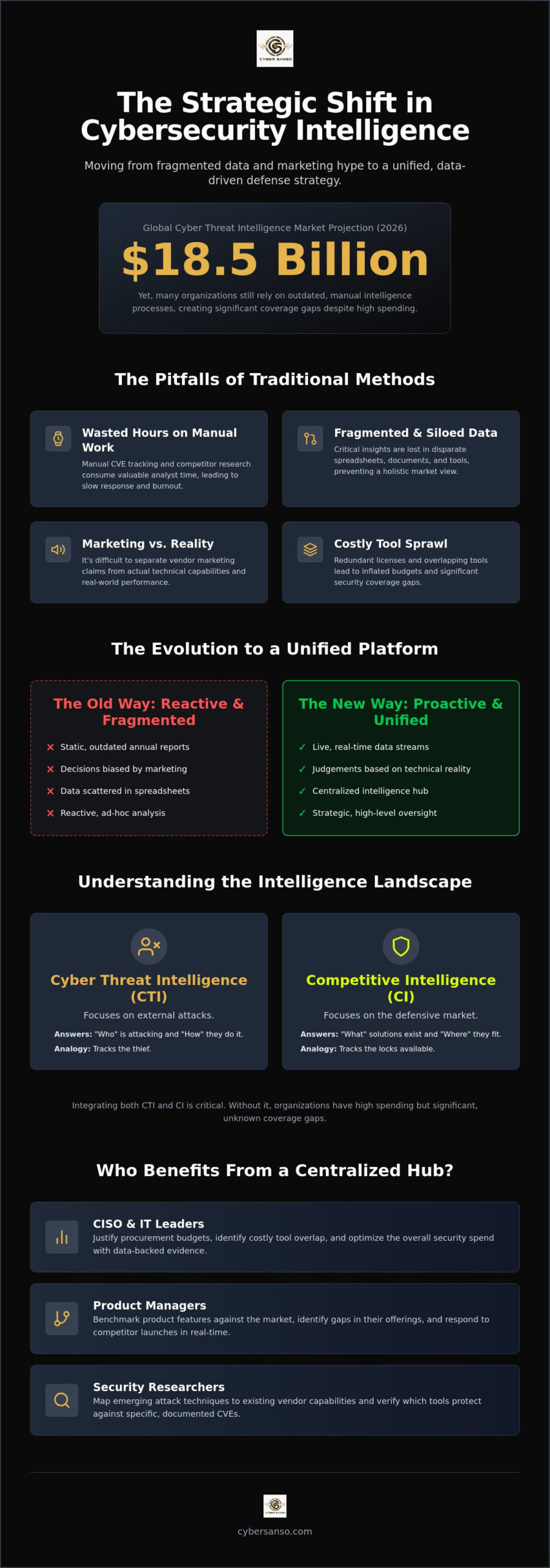
A cybersecurity competitive intelligence platform is a centralized hub designed to synthesize market dynamics with deep technical telemetry. It represents a significant departure from traditional CI, which often focused exclusively on sales enablement and revenue tracking. In the current environment, this technology bridges the gap between what a vendor claims in their marketing collateral and what their software actually achieves in production. Security leaders use these platforms to verify technical efficacy, track competitor product pivots, and monitor the shifting landscape of vulnerabilities across the entire vendor ecosystem.
It’s vital to distinguish this from Cyber Threat Intelligence (CTI). While CTI catalogs the “who” and “how” of external attacks, a Competitive Intelligence platform in the security sector focuses on the “what” and “where” of the defensive market. One tracks the thief; the other tracks the locks available on the market. By 2026, the global cyber threat intelligence market has reached $18.5 billion, but the real value lies in integrating this data with competitive insights to build a resilient, non-redundant security stack. Organizations that don’t bridge these silos often find themselves with significant coverage gaps despite high spending.
The Evolution of Strategic Security Intelligence
Static annual reports from major analyst firms no longer suffice in a market that shifts weekly. Modern intelligence demands a transition from alarmist reporting to a navigational approach. This evolution prioritizes clinical, objective data over the industry fluff often found in sponsored whitepapers. Automated, AI-driven hubs now aggregate live data points, ensuring that strategic decisions are based on the current state of a vendor’s capabilities rather than their roadmap promises from six months ago. Real-time data is the only reliable defense against the rapid cycles of AI-powered attacks and vendor consolidation.
Key Stakeholders: Who Benefits from a Centralized Hub?
The utility of a cybersecurity competitive intelligence platform extends across the entire organizational chart. It serves as a single source of truth for diverse teams:
- CISO and IT Leaders: These decision-makers use the hub to justify procurement budgets and identify costly tool overlap. It provides the transparency needed to prune redundant licenses and optimize the security budget.
- Product Managers: By benchmarking features against a comprehensive cybersecurity vendor database, they can identify gaps in their own offerings and respond to competitor launches in real-time.
- Security Researchers: They map emerging attack techniques to existing vendor capabilities. This allows them to identify which tools actually provide protection against specific CVEs and which are merely riding the wave of hype.
This structured approach ensures that every piece of information has a designated place within the larger ecosystem. It moves the organization away from reactive decision-making toward a model of high-level oversight and efficiency.
Core Components of a High-Impact Intelligence Workflow
Intelligence is not a static asset. It’s a dynamic process that requires the constant ingestion of technical data points to remain relevant. A high-impact workflow begins with a structured cybersecurity taxonomy that categorizes vendors by their specific technical architecture rather than their marketing labels. By organizing data into granular silos like Cloud Security Posture Management (CSPM) or Identity Threat Detection and Response (ITDR), organizations can eliminate the noise of broad market reports. A modern cybersecurity competitive intelligence platform facilitates this by integrating live technical telemetry directly into the strategic decision-making process.
This technical integration ensures that procurement and security operations teams work from the same source of truth. When technical vulnerability data and AI model shifts are synthesized into a single navigational hand, the organization gains a significant strategic advantage. Professionals looking to standardize these processes often look toward academic frameworks, such as those detailed in Georgetown’s Competitive Business Intelligence Certificate, which highlights the necessity of merging business strategy with technical oversight. This structured approach moves the CI function away from simple news tracking toward a model of rigorous, data-driven analysis.
The Technical Foundation: CVEs and Attack Libraries
Tracking the latest security vulnerabilities in 2026 is the most effective way to verify vendor claims. While a sales deck might promise comprehensive protection, a live CVE vulnerability tracker reveals the technical reality of a product’s attack surface. By utilizing an attack types and techniques library, researchers can map specific competitor capabilities against known adversary behaviors. CVE tracking serves as a primary leading indicator of a vendor’s internal research and development focus and their proactive commitment to product security. This data allows for the creation of dynamic battlecards that reflect real-world performance rather than theoretical features.
The Market Foundation: Curated Vendor Directories
Generic search engines are insufficient for deep technical research because they lack the necessary context to filter out sponsored content. A curated cybersecurity vendor database provides a filtered view of the market, allowing for precise segmentation by niche, such as OT security or AI-driven SaaS. Evaluating vendor listing services for data depth ensures that your intelligence is based on verified technical specifications. For those ready to move beyond manual spreadsheets, the CyberSanso vendor database offers a centralized resource for mapping the current market landscape. This foundation allows teams to identify tool overlap and justify procurement decisions with clinical precision.
With 97% of organizations now utilizing AI-enabled security solutions, the workflow must also include an LLM comparison hub. This component allows for the objective evaluation of AI-driven features, ensuring that the “AI-powered” label translates to actual defensive utility. By combining these technical and market foundations, the intelligence function becomes a reliable partner in organizational resilience.
Overcoming Fragmented Insights: The Hub vs. The Spreadsheet
Spreadsheets are where strategic intelligence goes to die. For many security teams, manual competitive research remains a labor-intensive process of reconciling disparate PDFs, marketing brochures, and internal notes. This fragmented approach creates a “tool sprawl” effect, where data remains siloed and inaccessible to key decision-makers. The hidden cost of this manual effort is not just wasted time; it’s the high probability of biased procurement. A centralized cybersecurity competitive intelligence platform acts as the corrective measure, providing a single source of truth for the entire industry ecosystem.
Fragmented data inevitably leads to security gaps. When procurement decisions are based on incomplete information, organizations often acquire redundant tools that fail to address their specific threat model. Transitioning to a hub-based model allows for a clear view of the defensive landscape, ensuring that every technological investment serves a distinct purpose. Implementing a cybersecurity competitive intelligence platform facilitates the transition from reactive monitoring to proactive strategic oversight, allowing teams to anticipate market shifts before they impact the organization’s posture.
The Risks of Marketing-Led Procurement
Marketing-led procurement is a primary driver of technical debt. In the 2026 AI security space, identifying “vapourware” is a constant challenge for researchers. Over 80% of social engineering attacks are now powered by AI, and vendors are rushing to claim defensive capabilities that may not yet exist in a stable form. Without independent resource hubs and clinical evaluation criteria, it’s difficult to distinguish between a functional product and a collection of roadmap promises. Using technical checklists and verifying vendor claims against a live CVE vulnerability tracker is essential for unbiased evaluation. Organizations that moved from scattered PDFs to a centralized intelligence platform report significantly higher confidence in their vendor selection process, as decisions are based on verified technical telemetry rather than sales narratives.
Building an Internal Intelligence Culture
Standardizing the evaluation process is the first step in building a resilient intelligence culture. By utilizing standardized security checklists and templates, organizations can ensure that every vendor is subjected to the same rigorous scrutiny. This structure helps educate non-technical stakeholders on the nuances of the security market, bridging the communication gap between the SOC and the boardroom. Modular, easy to scan intelligence reports provide C-suite stakeholders with the high-level oversight needed to align security investments with organizational risk tolerance without getting lost in technical minutiae. This architectural logic ensures that intelligence is not just collected, but utilized as a strategic asset across the entire enterprise.
How to Implement a Competitive Intelligence Strategy in 2026
Execution of a successful intelligence strategy requires moving beyond passive observation toward a model of rigorous, structured discovery. A high-level strategy isn’t just about collecting data; it’s about creating a repeatable workflow that informs procurement and operational defense. Implementing a cybersecurity competitive intelligence platform provides the necessary framework to synchronize these efforts across the enterprise. The following five-step process establishes a clinical foundation for strategic oversight.
Step 1: Define Intelligence Requirements. Start by identifying the specific technical and market gaps within your organization’s threat model. This alignment follows the “Govern” function of the NIST Cybersecurity Framework 2.0, ensuring that intelligence efforts support broader risk management objectives. Step 2: Map the Existing Stack. Cross-reference your current security architecture against a comprehensive Cybersecurity Vendor Database to identify functional redundancies and tool sprawl. Step 3: Monitor Vulnerabilities. Establish a daily cadence for reviewing a Live CVE Vulnerability Tracker to verify if your vendors are maintaining their security promises. Step 4: Audit Shadow AI. Utilize an AI tools and SaaS directory to identify unsanctioned AI deployments that may be bypassing traditional security controls. Step 5: Operationalize Findings. Distill the gathered intelligence into actionable Security Checklists and Templates that the SOC can use to adjust defensive configurations in real-time.
Auditing the Emerging AI Landscape
The AI in cybersecurity market is projected to reach $133 billion by 2030, creating a crowded field of new entrants. IT leaders must use an LLM Comparison Hub to benchmark internal and external models against objective performance criteria. Tracking AI security startups via specialized Cybersecurity and AI Company Listings allows for the early identification of innovative defensive technologies. Evaluating these vendors with generative AI security checklists ensures that “AI-powered” claims are backed by robust governance and technical efficacy. This structured auditing prevents the adoption of “vapourware” that fails to address the reality of AI-powered social engineering attacks.
Maintaining Data Currency
Static data is a liability in a landscape where 80% of social engineering attacks are now AI-driven. Automating insight gathering via a dedicated Cybersecurity News & Insights hub ensures that your team remains informed of competitor pivots and emerging exploits as they happen. Vendor listing services play a critical role here by providing verified, up-to-date product specifications that generic search engines often miss. Real-time exploit databases are critical for 2026 patching priorities because they provide the immediate technical context required to triage vulnerabilities before they’re weaponized. To begin centralizing your intelligence efforts and reducing manual research time, you can access the CyberSanso resource hub for a unified view of the security ecosystem.
CyberSanso: Your Strategic Cybersecurity Resource Hub
CyberSanso serves as the architectural foundation for organizations seeking a unified, data-driven intelligence strategy. By synthesizing a comprehensive Cybersecurity Vendor Database with a Live CVE Vulnerability Tracker, it provides a clinical perspective on vendor performance and technical efficacy. This integrated approach allows security leaders to move beyond fragmented research, establishing a single source of truth for the entire ecosystem. As a dedicated cybersecurity competitive intelligence platform, CyberSanso bridges the gap between raw technical data and high-level strategic oversight, ensuring that every investment is verified against real-world telemetry.
Accessing the right tools shouldn’t be a hurdle for security teams striving for efficiency. CyberSanso provides free Security Utilities and standardized Security Checklists and Templates to jumpstart your intelligence function immediately. These resources allow for a repeatable workflow, reducing the time spent on manual vendor research and ensuring that procurement decisions are based on objective criteria. By leveraging the LLM Comparison Hub, researchers can perform objective AI security research, ensuring that “AI-powered” tools meet necessary defensive standards before they’re integrated into the corporate environment.
A Comprehensive Suite for Security Professionals
Strategic defense requires a deep understanding of adversary behavior and the tools available to counter it. Navigating the Attack Types and Techniques Library allows professionals to map specific threats directly to existing vendor capabilities. This mapping ensures that the security stack remains resilient and non-redundant. For those managing the rapid adoption of generative AI, the AI Tools & SaaS Directory provides the enterprise-wide oversight needed to audit shadow AI deployments. CyberSanso’s cybersecurity competitive intelligence platform has become the preferred independent resource for 2026 because it prioritizes transparency and descriptive accuracy over traditional marketing narratives.
Join the Intelligence Ecosystem
The intelligence landscape is most effective when it’s collaborative, transparent, and current. Vendors can enhance their visibility and demonstrate technical transparency through specialized Vendor Listing Services, ensuring their product data remains accurate and accessible to decision-makers. Staying informed is a daily requirement for maintaining a defensible posture. Professionals can access the latest Cybersecurity News & Insights to track market shifts and emerging exploits in real-time. This commitment to data currency ensures that your defensive posture remains proactive rather than reactive in a fast-moving technical industry. To begin centralizing your strategic efforts and optimizing your security stack, Explore the CyberSanso Cybersecurity Resource Hub today.
Achieving Strategic Oversight in a Technical Market
The transition from manual research to a centralized cybersecurity competitive intelligence platform marks the difference between reactive procurement and proactive resilience. By synthesizing technical telemetry with market dynamics, security leaders can finally eliminate the bias inherent in sponsored analyst reports. It’s about establishing a single source of truth that remains current as the threat landscape shifts; this ensures every technological investment serves a distinct, verified purpose within the enterprise architecture.
Success in 2026 requires access to granular data points like Live CVE Vulnerability Tracking and a curated Industry Attack Library. Utilizing an Independent LLM Comparison Hub further ensures that your AI defensive strategies are grounded in technical reality rather than roadmap promises. You’re now equipped to move beyond fragmented spreadsheets and build a defensible, non-redundant security stack that stands up to clinical scrutiny. Explore the Comprehensive Cybersecurity Vendor Database to begin centralizing your strategic research and optimizing your defensive posture. High-level oversight is within your reach.
Frequently Asked Questions
What is the difference between threat intelligence and competitive intelligence in cybersecurity?
Threat intelligence focuses on adversary telemetry, identifying the specific actors, motives, and techniques used in external attacks. In contrast, a cybersecurity competitive intelligence platform tracks market telemetry, focusing on the defensive capabilities, product pivots, and technical efficacy of vendor solutions. While threat intelligence catalogs the “who” of a breach, competitive intelligence catalogs the “what” of the defensive market, providing a clinical view of the tools available to counter emerging threats.
How can a cybersecurity resource hub help with SOC2 compliance?
A centralized hub provides the structured documentation required for the vendor management and third-party risk assessment portions of a SOC2 audit. By utilizing standardized security checklists, organizations can demonstrate a repeatable process for evaluating the security posture of their software supply chain. This evidence is critical for auditors to verify that your organization maintains high-level oversight of its technical partners and adheres to rigorous internal governance standards.
Why should I use a specialized cybersecurity vendor database instead of a general search engine?
General search engines prioritize sponsored content and broad SEO rankings, which often obscure technical reality with marketing narratives. A specialized database provides a clinical, filtered view of the industry, allowing for precise segmentation by niche categories like OT security or AI-driven SaaS. It ensures that your research is based on verified technical specifications rather than roadmap promises or industry fluff found in commercial search results.
How often is the live CVE vulnerability tracker updated on CyberSanso?
The live tracker is updated in real-time as new vulnerabilities are published through official technical telemetry sources and the National Vulnerability Database. This continuous ingestion ensures that security teams have immediate visibility into emerging exploits affecting their vendor ecosystem. Maintaining this level of data currency is essential for triaging patching priorities and managing technical debt in a landscape where AI-powered attacks are increasingly common.
Can I use the LLM comparison hub to evaluate the security of different AI models?
Yes, the hub is designed specifically for the objective benchmarking of AI features and their associated security controls. It allows researchers to compare large language models against specific defensive criteria, helping to identify “vapourware” in the AI security space. This independent evaluation is critical for IT leaders who need to audit the technical efficacy of AI tools before enterprise-wide deployment, ensuring that models meet organizational risk tolerance.
What are the benefits of listing my company on a cybersecurity vendor marketing platform?
Listing your company ensures that your technical specifications are accurately represented to a specialized audience of CISOs and procurement leaders. These platforms serve as high-intent environments where decision-makers actively search for solutions to specific security gaps. It improves your visibility within the industry ecosystem and positions your brand as a transparent, reliable participant in the defensive market, which is essential for building trust in 2026.
Are the security checklists and templates on CyberSanso free to use?
CyberSanso provides a variety of free security utilities, including standardized templates and checklists, to support the broader security community. These resources are designed to help organizations implement a repeatable intelligence workflow without the need for high-end enterprise licensing. They serve as a foundational tool for teams looking to standardize their vendor evaluation processes and reduce the manual effort required to track competitor launches and CVEs.
How does CyberSanso help in mitigating security tool sprawl?
CyberSanso allows you to map your current technology stack against a comprehensive cybersecurity competitive intelligence platform to identify functional redundancies. By visualizing your entire defensive landscape in one hub, you can easily spot tool overlaps where multiple products provide the same security outcome. This clinical analysis enables organizations to prune redundant licenses and optimize their security budget, ensuring that every tool in the stack serves a unique and necessary purpose.