
The 2026 cybersecurity market is a paradox of consolidation and fragmentation. While enterprise platforms acquire smaller players in a push for unified security suites, a new wave of micro-niche innovators continues to emerge, particularly at the intersection of AI and security. For CISOs, procurement officers, and security researchers, this landscape creates significant operational friction. Navigating thousands of vendors, distinguishing technical efficacy from marketing hype, and rationalizing an already bloated security stack has become a strategic challenge in itself. Traditional vendor lists are no longer sufficient.
In 2026, a cybersecurity vendor database is not a phone book; it is a strategic navigation system. To be effective, it must move beyond static listings and integrate live threat intelligence, operational templates, and a clinical taxonomy that treats cybersecurity and AI as a converged ecosystem. This guide provides a framework for using such a database to master the modern security landscape, evaluate vendor intelligence, and strategically eliminate tool sprawl.
Navigating the 2026 Cybersecurity Vendor Landscape: Beyond Simple Listings
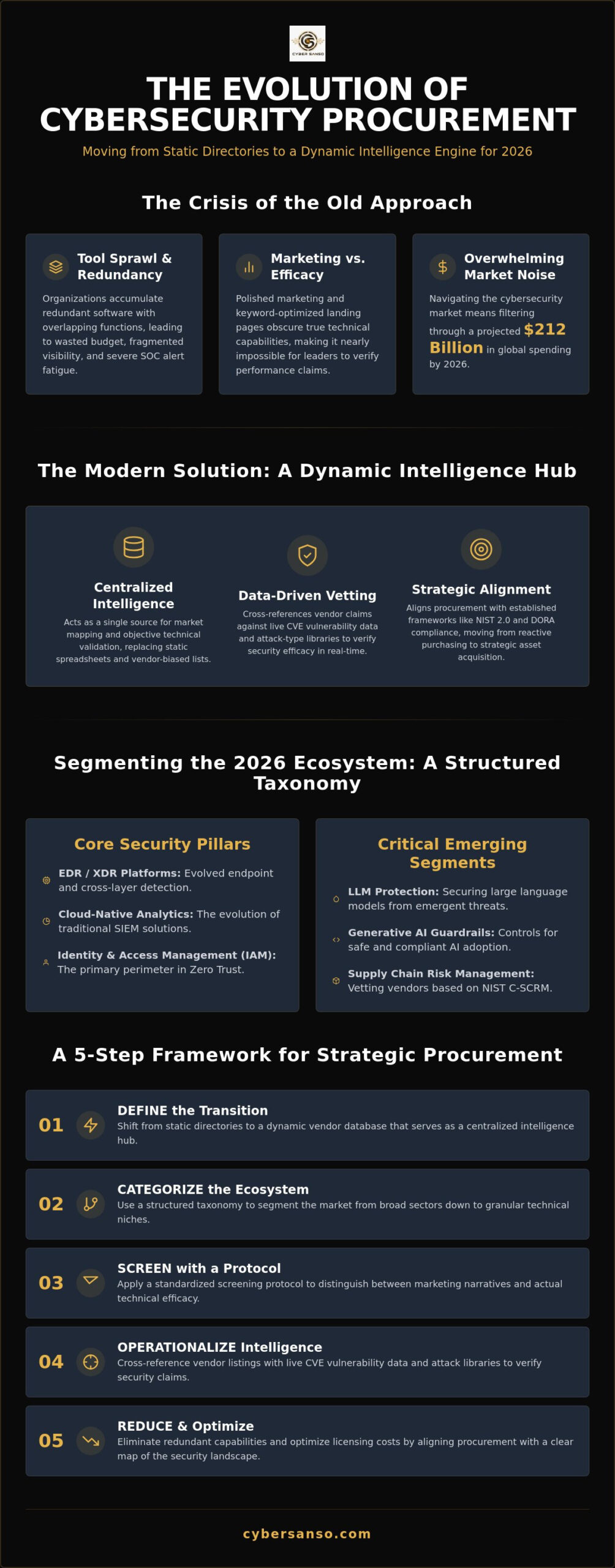
A modern cybersecurity vendor database is best defined as a centralized intelligence hub used for market mapping, technical verification, and procurement strategy. Unlike a standard search engine, which struggles to parse nuanced technical capabilities and often prioritizes paid placements, a curated database provides a structured, objective lens through which to view the market. This is critical in an environment defined by two opposing forces: the “Great Consolidation,” where large vendors absorb niche technologies, and “Micro-niche Innovation,” where specialized startups address emerging threats like those targeting Large Language Models (LLMs).
The core function of an independent curator is to mitigate procurement anxiety. By providing a pre-vetted, logically segmented view of the vendor ecosystem, these platforms reduce the labor of filtering and allow security teams to focus on strategic alignment rather than endless discovery. They serve as a buffer against marketing claims, offering a data-driven foundation for decision-making.
The Evolution of Vendor Intelligence
Vendor intelligence has evolved significantly. The era of static spreadsheets and annual reports has given way to dynamic, live-tracked intelligence platforms. This shift is driven by the sheer velocity of the market; a database that is not updated in near real-time is obsolete upon publication. The modern imperative is for “clinical” data—verifiable technical specifications, compliance certifications, and objective capability mapping—over the marketing-heavy brochures that dominate vendor websites. For this intelligence to be trustworthy, its source must be independent. A database that operates on vendor commissions or paid placement models inherently compromises its integrity, transforming from a research tool into an advertising platform.
Addressing the Crisis of Security Tool Sprawl
Security tool sprawl refers to the accumulation of disparate, often overlapping security solutions within an organization. This proliferation leads to integration challenges, increased management overhead for Security Operations Center (SOC) teams, and redundant licensing costs. A primary strategic use of a cybersecurity vendor database is to combat this inefficiency. By mapping the capabilities of an existing security stack against the database’s structured taxonomy, leaders can identify functional overlaps with clinical precision. For example, they can determine if a proposed Endpoint Detection and Response (EDR) solution offers features already covered by their existing Extended Detection and Response (XDR) platform. In the budget-conscious environment of 2026, the ability to rationalize the security budget by eliminating redundant tools is not just an operational goal but a financial imperative.
Essential Taxonomy: Segmenting the Cybersecurity and AI Vendor Ecosystem
An effective cybersecurity vendor database cannot be a flat, alphabetical list. Such a structure is useful only for brand recognition and fails completely when a user needs to compare vendors within a specific technical niche. The value of a database lies in its taxonomy—the logical segmentation of the market. This segmentation should follow a “Macro-to-Micro” rhythm, allowing a user to start with broad domains and drill down into granular sub-categories.
The primary macro categories remain foundational: Endpoint Security, Network Security, Identity and Access Management (IAM), and Cloud Security. However, the 2026 landscape demands the integration of an emerging and critical segment: AI Security. This includes solutions for LLM protection, Generative AI guardrails, and AI-driven threat detection. Crucially, the taxonomy must also account for “Cross-Category” vendors—often large, established platforms that offer solutions bridging multiple silos, such as a single platform providing both Cloud Security Posture Management (CSPM) and Data Loss Prevention (DLP).
Core Cybersecurity Segments
Within the foundational domains, a granular taxonomy is essential for meaningful comparison. For instance, the Endpoint Security category must be subdivided into EDR, XDR, Mobile Threat Defense (MTD), and Vulnerability Management. The database should allow users to compare vendors specializing in Zero Trust architectures or to filter for solutions specific to Operational Technology (OT) security, a segment of growing importance for protecting national critical infrastructure. Further segmentation by vendor maturity—distinguishing venture-backed startups from enterprise-grade incumbents—provides crucial context for risk assessment and procurement, as a CISO’s requirements for a SOC2-compliant enterprise platform differ vastly from a research team’s need for a cutting-edge niche tool.
The AI Tools and SaaS Directory Integration
Treating AI security as a separate, isolated category is a critical mistake. In 2026, it is a converged ecosystem. A forward-looking database must integrate AI tools and SaaS directories directly into its cybersecurity taxonomy. AI security vendors should be categorized not just by their function but also by the foundation models they protect (e.g., GPT-4, Claude 3) and their intended industry application (e.g., healthcare, finance). An integrated LLM Comparison Hub becomes an essential tool, allowing teams to evaluate models based on security features, data privacy policies, and known vulnerabilities. Furthermore, a comprehensive SaaS directory helps security teams track and manage “Shadow AI”—the unsanctioned use of third-party AI tools by employees—by identifying which applications are present within their network and assessing their associated risks.
Strategic Procurement: A Framework for Evaluating Security Vendors
Providing data is not enough. A strategic database must also provide a methodology for using that data to make sound decisions. Many directories target CISOs with lists of vendors but offer no actionable framework for the evaluation process itself. The goal is to move beyond simple comparison and establish a standardized, repeatable protocol for vendor screening, technical verification, and risk assessment.
This framework should empower teams to differentiate between marketing hype and true technical efficacy, especially during vendor demos. It involves leveraging objective data points within the database, such as third-party certifications (e.g., SOC2, ISO 27001), to validate vendor claims. By using standardized checklists and templates, procurement becomes a structured, evidence-based process rather than a subjective one.
The 4-Step Evaluation Methodology
A clinical approach to vendor evaluation can be broken down into four distinct steps, transforming the database from a research source into an active procurement tool.
- Step 1: Gap Analysis. Begin by mapping your current security stack’s capabilities. Use the database’s taxonomy to systematically review your coverage across key areas like endpoint, cloud, and identity. This process reveals critical gaps in your defenses, providing a clear, data-driven justification for seeking a new solution. Instead of reacting to a vendor pitch, you are proactively identifying a need.
- Step 2: Technical Verification. Once a shortlist of vendors is identified, cross-reference their claimed capabilities with objective, third-party resources. A database integrated with an attack techniques library (like MITRE ATT&CK) allows you to ask hyper-specific questions during a demo, such as, “Show me precisely how your platform mitigates T1566 Phishing techniques.” This grounds the conversation in technical reality.
- Step 3: Compliance Check. Utilize the database to filter vendors based on non-negotiable compliance requirements. Check for essential certifications like SOC2 Type II, ISO 27001, or FedRAMP. Employ standardized security audit templates and vendor risk assessment checklists to ensure every potential partner meets your organization’s security and privacy standards before proceeding to contract negotiations.
- Step 4: Future-Proofing. Assess the vendor’s long-term viability and strategic direction. A robust database profile should include information on a vendor’s R&D investment, product roadmap, and, critically, their strategy for AI and cloud-native environments. This step ensures you are not just buying a solution for today’s problems but investing in a partner who can adapt to tomorrow’s threats.
Avoiding the Marketing Hype Trap
The cybersecurity industry is notorious for its use of buzzwords and marketing-driven claims. In 2026, terms like “AI-powered,” “next-generation,” and “military-grade” are often used without substantiation. A key skill is learning to ignore this language and focus on verifiable data. Use the raw statistics and feature lists in the database to fact-check vendor claims. If a vendor claims to have the “most comprehensive threat intelligence,” verify that against their listed integrations and data sources. The communication style of a vendor is also telling. Prioritize partners who use “clinical” language—specific, measurable, and calm—over those who rely on “alarmist” communication designed to create fear, uncertainty, and doubt (FUD).
Operational Intelligence: Integrating CVE Tracking and Security Checklists
The most significant leap in the evolution of the cybersecurity vendor database is its transformation from a static research tool into a dynamic operational intelligence platform. Its value multiplies when it is integrated with live utility tools that inform daily security operations. A vendor’s capabilities are only relevant in the context of the threats an organization is currently facing.
This requires a direct synergy between the vendor database and a Live CVE Vulnerability Tracker. When a new critical vulnerability is announced, a security team’s first questions are: “Are we exposed?” and “Which of our tools can mitigate this?” An integrated system can answer this immediately. Similarly, a library of attack types and security checklists moves the platform from pre-purchase research to post-purchase implementation, providing ready-to-use templates that standardize and accelerate the onboarding of new tools.
Live Vulnerability Mapping
Live vulnerability mapping connects threat intelligence directly to procurement and vendor management. By tracking the latest Common Vulnerabilities and Exposures (CVEs), an integrated database can instantly highlight which vendors in a given category offer specific mitigations for a new, high-profile exploit. This real-time data flow fundamentally informs procurement in 2026: vendor selection is no longer based solely on a feature list but on a demonstrated ability to respond to active, in-the-wild threats. This capability also allows security teams to use real-time exploit data to prioritize patching schedules and hold their existing vendors accountable for their service-level agreements (SLAs).
Standardizing with Security Templates
Operational efficiency is built on standardization. A database that includes a library of security templates and checklists reduces the “labor of filtering” for security teams at every stage. During procurement, a standardized SaaS vendor security assessment checklist ensures that every potential partner is evaluated against the same rigorous criteria. After purchase, SOC templates for logging, alerting, and incident response help accelerate the onboarding of a new tool into the existing workflow. These resources transform the database from a repository of information into a platform for action, ensuring that the intelligence gathered during research is translated directly into consistent, defensible security operations.
CyberSanso: The Unified Intelligence Hub for Security Professionals
CyberSanso is engineered to be the operational intelligence hub that the 2026 security landscape demands. As a seasoned, independent curator of security data, our platform is built on a foundation of objective, clinical analysis. We provide the unique combination of a comprehensive cybersecurity vendor database, a curated AI Tools and SaaS Directory, and integrated technical utilities designed for the modern security professional.
Our “Macro-to-Micro” information architecture allows users to navigate the complex vendor ecosystem with efficiency and precision. We connect vendor research directly to operational needs through our Live CVE Vulnerability Tracker and a library of ready-to-use security checklists. For vendors, CyberSanso offers a direct channel to increase visibility and reach specialized, high-intent decision-makers within a trusted, curated environment.
Access the Comprehensive Cybersecurity Vendor Database
A Comprehensive Resource Library
Beyond vendor listings, CyberSanso serves as a deep resource for technical verification and strategic research. Professionals can access our Attack Types and Techniques Library to stress-test vendor claims against known adversary tactics. Our LLM Comparison Hub provides the granular detail needed for model-level security selection in the age of generative AI. And our curated cybersecurity news and insights keep teams informed on the trends and threats shaping the industry, all within a single, unified platform.
Enhanced Visibility for Vendors
For cybersecurity and AI companies, being listed in a generic directory is not enough. Reaching the right audience requires being part of a curated industry ecosystem where security leaders and procurement officers conduct their primary research. CyberSanso provides a platform for vendors to showcase their technical capabilities to a specialized audience actively seeking solutions. A listing in our database places your company within the strategic workflow of decision-makers, enhancing brand credibility and generating high-quality leads.
Ready to connect with security leaders? Explore the CyberSanso Vendor Database and learn how our listing services can elevate your market presence.
Frequently Asked Questions
What is a cybersecurity vendor database and how is it used?
A cybersecurity vendor database is a centralized, curated platform that lists and categorizes security technology vendors. It is used by security leaders, procurement teams, and researchers to discover, compare, and evaluate solutions, analyze market trends, perform gap analysis on their existing security stack, and streamline the procurement process.
How often is the CyberSanso vendor database updated?
Our database is a dynamic platform updated continuously to reflect new vendor entries, product updates, M&A activity, and emerging market categories. This live-tracking model ensures the intelligence remains relevant and accurate.
Can I list my AI tool or cybersecurity company on CyberSanso?
Yes, we offer listing services for cybersecurity and AI companies that meet our curation criteria. A listing on CyberSanso provides enhanced visibility to a targeted audience of security professionals and decision-makers.
What is the difference between a vendor directory and a vulnerability tracker?
A vendor directory lists companies and their products. A vulnerability tracker (like a CVE database) lists known software security flaws. A platform like CyberSanso integrates the two, allowing users to see which vendors offer solutions that mitigate specific, real-time vulnerabilities.
How do security checklists help with vendor risk assessment?
Security checklists provide a standardized framework for evaluating a vendor’s security posture. They ensure that all critical areas—such as data encryption, access controls, compliance certifications, and incident response processes—are consistently and thoroughly vetted for every potential vendor, reducing risk and ensuring due diligence.
Why is an LLM comparison hub necessary for AI security?
As companies integrate Large Language Models into their operations, they must assess the inherent security and privacy risks of each model. An LLM comparison hub provides a structured way to evaluate different models on security-specific criteria, such as data retention policies, training data sources, and resistance to prompt injection attacks, which is essential for secure AI adoption.
What are the most important categories in a cybersecurity directory today?
The most critical categories include foundational areas like Endpoint Security (EDR/XDR), Cloud Security (CSPM/CNAPP), and Identity & Access Management (IAM) with a focus on Zero Trust. Additionally, emerging categories like AI Security (LLM Guardrails) and Operational Technology (OT) Security are rapidly growing in importance.
How does CyberSanso ensure the independence of its vendor listings?
CyberSanso is an independent intelligence platform. Our taxonomy and vendor categorization are based on objective technical analysis and market research conducted by our team. While we offer paid listing services for enhanced visibility, a vendor’s placement within our database is determined by its capabilities, not its budget, ensuring the integrity of our data.