
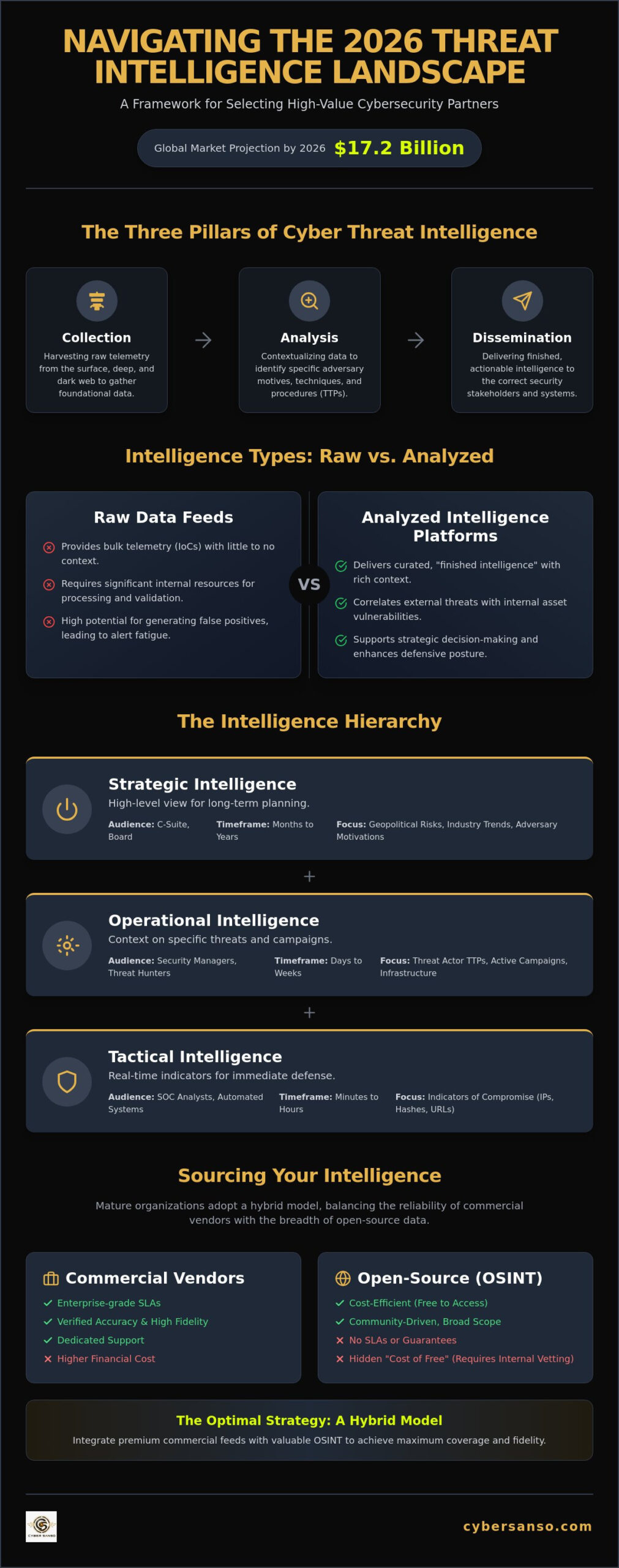
Threat intelligence is not merely a product list; it is a navigational strategy that requires matching vendor output to your specific organizational maturity. By 2026, the global market for these services is projected to reach 17.2 billion dollars, yet many security leaders still struggle to extract actionable value from their investments. You’ve likely experienced the friction of low-fidelity feeds that trigger endless false positives or the challenge of justifying a premium threat intelligence vendor list to a board focused on the bottom line. It’s a common struggle to manage high-cost platforms that fail to integrate seamlessly with your existing SIEM or XDR stacks.
This guide provides a clinical, high-level directory and an objective evaluation framework designed to mitigate the sense of overwhelm. We’ve performed the labor of filtering the landscape to present a vetted selection of providers categorized by technical strengths and industry focus. You’ll gain a clear methodology for selecting partners that reduce noise and enhance your defensive posture. We’ll examine the top-tier vendors for 2026, analyze the impact of the CMMC 2.0 rollout on selection criteria, and detail how to align external data with your internal security architecture.
- Distinguish between raw telemetry feeds and analyzed intelligence platforms to establish a foundation of evidence-based hazard knowledge.
- Evaluate a comprehensive threat intelligence vendor list categorized by strategic utility to ensure alignment with executive decision-making and technical operations.
- Apply rigorous selection criteria focused on geographic relevance and the verified ratio of true positives to false positives.
- Review clinical profiles of 2026 market leaders and emerging AI-native challengers to identify the most effective partners for your risk profile.
- Leverage the CyberSanso Cybersecurity Vendor Database and Live CVE Vulnerability Tracker to mitigate tool sprawl and verify detection capabilities.
Defining the Threat Intelligence Vendor Landscape in 2026
Cyber Threat Intelligence (CTI) is evidence-based knowledge, including context, mechanisms, indicators, and actionable advice regarding existing or emerging hazards. By 2026, the industry has transitioned from simply reacting to indicators of compromise (IoCs) to a model focused on proactive adversary profiling. Understanding the foundational concepts of threat intelligence is critical for leaders evaluating any threat intelligence vendor list. This landscape is anchored by three core pillars that define a provider’s utility:
- Collection: The ability to harvest raw telemetry from the surface, deep, and dark web.
- Analysis: The process of contextualizing data to identify specific adversary motives and techniques.
- Dissemination: The efficient delivery of finished intelligence to the correct security stakeholders.
There’s a fundamental distinction between raw data feeds and analyzed intelligence platforms. Feeds provide bulk telemetry, which often requires significant internal resources for processing and validation. Platforms, however, offer curated insights that correlate external threats with internal asset vulnerabilities. This shift reflects a move toward “finished intelligence” that supports strategic decision-making rather than just technical blocking at the perimeter.
The Evolution of Threat Intelligence Requirements
Static blacklists are obsolete. In an era where polymorphic malware and ephemeral infrastructure are the norm, relying on IP-based blocking is insufficient. Modern requirements focus on behavioral patterns and Tactics, Techniques, and Procedures (TTPs) rather than fixed signatures. AI now automates the processing of vast amounts of unstructured data, turning raw logs into prioritized alerts. This evolution is accelerated by 2026 compliance standards, such as the EU’s Digital Operational Resilience Act (DORA) and the U.S. CMMC 2.0, which mandate that organizations maintain high levels of external threat visibility to ensure operational resilience.
Commercial vs. Open-Source Intelligence (OSINT)
Open-source intelligence remains a valuable component of the security stack. GitHub-sourced tools and community repositories are often sufficient for niche research or initial SOC triage. However, the “cost of free” is often overlooked. Commercial vendors provide enterprise-grade SLAs, verified accuracy, and dedicated support that OSINT projects can’t match. Most mature organizations adopt a hybrid model. They integrate community-driven lists with premium feeds found on a professional threat intelligence vendor list to ensure both breadth and high-fidelity detection. This approach balances the cost-efficiency of open-source data with the reliability of commercial intelligence providers.
Categorizing Threat Intelligence Providers by Utility
An effective threat intelligence vendor list is not a monolithic directory. It’s a tiered ecosystem where utility is defined by the intended consumer and the timeframe of the intelligence. Strategic, operational, and tactical categories serve distinct functions within a mature security program. Understanding these nuances prevents the common pitfall of purchasing high-cost strategic reports for a SOC that lacks the bandwidth to process them. Proper categorization ensures that the data stream matches the technical and cognitive capacity of the receiving team.
Strategic intelligence provides the macro view. It analyzes geopolitical risks, industry-specific trends, and long-term adversary motivations. This data helps CISOs and board members allocate budgets and model risks over multi-year horizons. Organizations often participate in initiatives like CISA’s Cyber Threat Information Sharing program to gain this high-level visibility alongside commercial offerings. This collaborative approach allows for a broader understanding of the threat landscape beyond an organization’s immediate perimeter.
Operational intelligence shifts the focus to specific threat actor groups. It tracks their current campaigns, preferred infrastructure, and evolving TTPs. This layer bridges the gap between executive risk and technical defense. Tactical intelligence is the most granular. It consists of Indicators of Compromise (IOCs) such as malicious URLs, file hashes, and IP addresses. This real-time telemetry is designed for automated ingestion into security stacks for immediate blocking and alert enrichment.
Strategic Intelligence Specialists
These vendors prioritize context over volume. They deliver deep-dive white papers and executive briefings that detail the “who” and the “why” behind cyberattacks. Their work is essential for long-term risk modeling and understanding how regional conflicts or economic shifts might impact an organization’s threat profile. To find specialized providers in this category, leaders can consult the CyberSanso vendor database to filter by strategic focus and industry relevance.
Operational and Tactical Feed Providers
These providers focus on the “what” and the “how.” Their primary deliverables are machine-readable feeds delivered via API for seamless integration with SIEM, SOAR, and EDR platforms. Speed and fidelity are the primary metrics here. Incident Response (IR) teams and SOC analysts rely on this data to enrich alerts and shorten the mean time to detect (MTTD). Effective tactical providers offer high-fidelity telemetry that minimizes the noise of false positives in high-velocity environments, ensuring that security teams focus on genuine threats.
Key Evaluation Criteria for Your Threat Intelligence Vendor List
Selecting the right partners for your threat intelligence vendor list requires a shift from feature-based checklists to operational outcome metrics. A vendor’s value isn’t determined by the volume of data they provide, but by how effectively that data reduces your mean time to detect (MTTD) and respond (MTTR). High-volume feeds often introduce significant noise, which can overwhelm a SOC and lead to alert fatigue. To avoid this, security leaders must prioritize five critical evaluation pillars:
- Relevance: Does the vendor have a proven track record in your specific industry and geographic region? Intelligence that focuses on financial sector threats in North America is of limited use to a manufacturing firm in Southeast Asia.
- Fidelity: What is the verified ratio of true positives to false positives? Low-fidelity data forces analysts to perform manual verification, which negates the efficiency gains of automated feeds.
- Timeliness: How many minutes or hours pass between the discovery of a zero-day exploit and the delivery of actionable telemetry? In a 2026 threat environment, delays of even an hour can be catastrophic.
- Integration: Does the platform support industry standards like STIX/TAXII, or does it rely on proprietary APIs that require custom engineering? Seamless integration with your existing SIEM, SOAR, and EDR stacks is non-negotiable.
- Actionability: Does the intelligence include specific remediation steps, or is it merely a collection of raw logs? Effective vendors provide the “so what” and “now what” for every alert.
Integration capabilities often dictate the shelf-life of intelligence. If data cannot be ingested and acted upon automatically, its value decays rapidly. Leaders should look for vendors that offer modular delivery, allowing you to subscribe only to the categories that align with your current risk profile. This modularity prevents “tool sprawl” and ensures that you aren’t paying for telemetry that your team lacks the capacity to process. Complementing your threat intelligence stack with a refined vulnerability management tools list ensures that external adversary insights translate directly into prioritized remediation actions across your attack surface.
The MITRE ATT&CK Mapping Test
Modern evaluation requires moving beyond the “what” of an attack to the “how.” A robust vendor must map their intelligence directly to the MITRE ATT&CK framework. This mapping allows your team to visualize which stages of the adversary lifecycle are most visible to your current defenses. You can use the CyberSanso Attack Types and Techniques Library to cross-reference a vendor’s claims against documented adversary behaviors, ensuring their detection capabilities match the real-world tactics used by your primary threat actors.
Data Sovereignty and Compliance in TI
Compliance is no longer a secondary concern in threat intelligence selection. With the full application of the Digital Operational Resilience Act (DORA) and the phased rollout of CMMC 2.0, where your data is hosted and processed carries legal weight. Vendors must be transparent about their data sourcing and verification processes. You need to ensure that cross-border threat sharing doesn’t violate national regulations or expose sensitive telemetry to unauthorized jurisdictions. Demand clear documentation on data residency and the vendor’s own security posture before finalizing your selection.
The 2026 Threat Intelligence Vendor List: Leaders and Challengers
The 2026 threat intelligence vendor list is bifurcated between standalone “Intelligence Clouds” and integrated security platforms. This division reflects a strategic choice for security leaders: prioritize deep, independent research or favor the operational speed of bundled telemetry. While the global cyber threat intelligence market is valued at approximately 17.2 billion dollars in 2026, the real differentiator among providers is their ability to monitor the deep web versus the surface web. Surface web monitoring tracks public CVEs and social media trends, whereas deep web capabilities focus on clandestine forums and leaked credential repositories where many modern attacks originate.
Specialized vendors are also carving out niches by focusing on specific stages of the vulnerability lifecycle. Some providers excel at identifying zero-day exploits before they are indexed, while others prioritize the “long tail” of legacy vulnerabilities that still plague enterprise environments. This segmentation allows organizations to build a multi-vendor strategy that covers both high-velocity emerging threats and the persistent risks associated with unpatched infrastructure. Effective selection requires a clear understanding of whether a vendor’s data collection methods align with your primary attack surface. Organizations managing a large volume of disclosed CVEs should also evaluate how their vulnerability management tools list integrates with threat intelligence feeds to prioritize remediation based on real-world exploitability rather than static severity scores.
Established Market Leaders
Intelligence Clouds, such as Recorded Future, provide a comprehensive view of the global threat landscape by aggregating data across massive, disparate datasets. Conversely, security platforms like Mandiant (now part of Google Cloud) offer intelligence that is deeply integrated with their own detection and response tools. Bundling intelligence within a broader security stack provides immediate operational speed, but it can create a “vendor lock-in” effect that limits visibility into threats not directly targeting those specific tools. By 2026, the operational segment of the market holds a 45.7% share, reflecting a clear industry preference for intelligence that directly fuels automated defensive actions. These leaders remain the gold standard for organizations requiring high-fidelity data with proven global reach.
Niche and Emerging AI-Native TI Vendors
Startups are currently disrupting the traditional model by using Large Language Models (LLMs) to synthesize complex threat reports in real-time. These AI-native platforms move beyond simple data aggregation to provide automated adversary emulation and breach-and-attack simulation (BAS). These tools allow teams to test their defenses against the exact TTPs identified in the latest intelligence feeds without manual intervention. For specialized tracking of software flaws, organizations are increasingly utilizing tools like a Live CVE Vulnerability Tracker to verify how quickly vendors update their detection rules following a disclosure. To explore the full range of modern providers, you can consult the CyberSanso AI Tools & SaaS Directory to identify vendors that match your specific technical requirements. Explore our full database to compare intelligence providers with clinical precision.
Optimizing Procurement via the CyberSanso Vendor Database
Procurement efficiency is the final hurdle in translating technical intelligence into operational resilience. Security leaders often find that their threat intelligence vendor list grows alongside their security debt, leading to significant tool sprawl and overlapping telemetry. The CyberSanso Cybersecurity Vendor Database serves as a strategic hub where you can compare TI providers alongside AI-native security tools in a unified environment. This centralized oversight allows decision-makers to identify redundancies before signing multi-year contracts, ensuring that every new feed adds unique value to the existing stack. By filtering providers through an independent lens, you mitigate the risk of paying for the same data across multiple platforms.
Verifying vendor performance requires more than reviewing marketing collateral. You can leverage the CyberSanso Live CVE Vulnerability Tracker to test a vendor’s detection speed against real-world disclosures. If a provider claims near-instantaneous updates, cross-referencing their output against the tracker’s live data provides a clinical proof of performance. Additionally, utilizing standardized templates for vendor risk assessments and SOC2 audits streamlines the compliance phase of procurement. These utilities allow your team to focus on technical validation rather than administrative friction, accelerating the time-to-value for your intelligence investments.
Centralizing Your Security Intelligence
Independent intelligence sources provide a level of transparency that vendor-specific documentation cannot match. By accessing a neutral platform, you bypass the bias inherent in proprietary research and gain a macro-view of the market. CyberSanso offers a suite of security checklists and templates specifically designed for the procurement phase. These resources help security architects define their requirements with precision, ensuring that the selected threat intelligence vendor list aligns with the organization’s specific technical maturity and risk profile. This structured approach provides a steady hand during complex negotiations with global providers.
Next Steps: From List to Implementation
The transition from a vetted list to a deployed solution should follow a methodical proof-of-concept (POC) involving your top three candidates. During this phase, focus on specific KPIs such as the reduction in false positives and the speed of automated ingestion into your SIEM or XDR. Establishing clear ROI metrics early ensures that the platform remains justifiable to stakeholders during annual budget reviews. Once you’ve defined your requirements and identified your primary adversary profiles, you can Explore the full Cybersecurity Vendor Database on CyberSanso to begin your selection process with verified, high-level oversight.
Advancing Toward Intelligence-Led Defense
Building a resilient security posture in 2026 requires more than just high-volume data feeds. It demands a clinical alignment between external telemetry and internal operational capacity. You’ve seen that the most effective strategies prioritize high-fidelity, industry-specific insights over generic blacklists. By transitioning from reactive indicators to proactive adversary profiling, your team can finally move ahead of the threat lifecycle. Success in this landscape isn’t about the quantity of data; it’s about the precision of the analysis.
Refining your threat intelligence vendor list shouldn’t be a source of technical overwhelm. A structured approach to procurement, supported by independent verification, ensures that every investment translates into reduced risk and fewer false positives. You can verify vendor claims and optimize your security stack by utilizing specialized utilities that bridge the gap between raw data and actionable intelligence. This methodical path ensures your resources are spent on defense rather than data management.
To begin your evaluation with objective authority, Access the Comprehensive Cybersecurity Vendor Database. Leverage our Live CVE Vulnerability Tracker, explore the Independent LLM Comparison Hub, and navigate our Curated Cybersecurity & AI Directory to find the right partners for your organization. With the right framework in place, you can bring order to a chaotic environment and protect your digital assets with confidence.
Frequently Asked Questions
What is the difference between a Threat Intelligence Feed and a Platform?
A Threat Intelligence Feed is a raw stream of technical indicators while a Platform provides a comprehensive environment for analysis and integration. Feeds deliver bulk data like malicious IPs or file hashes that require an existing security stack to process. Platforms offer the architectural logic to correlate these external hazards with your internal assets, providing the “finished intelligence” necessary for strategic oversight.
How much should an enterprise budget for a threat intelligence vendor list?
Budgeting for a threat intelligence vendor list depends on your organization’s required level of specialized visibility and technical maturity. While the market is expanding rapidly, costs are generally determined by the breadth of deep web monitoring and the frequency of high-fidelity updates. Leaders should evaluate the total cost of ownership, including the personnel hours saved through reduced false positives and automated remediation workflows.
Can I rely solely on open-source threat intelligence (OSINT)?
Relying exclusively on OSINT is insufficient for organizations with complex risk profiles or high-compliance requirements. Open-source data often lacks the timeliness and verified accuracy required to stop sophisticated campaigns before they impact production. While community lists are excellent for initial triage, they don’t provide the enterprise-grade SLAs or dedicated research support that commercial providers offer during active incidents.
How does MITRE ATT&CK integration improve vendor selection?
MITRE ATT&CK integration transforms vendor selection from a feature comparison into a gap analysis of your defensive capabilities. It allows you to see exactly which adversary tactics and techniques a vendor’s data covers, ensuring you aren’t paying for redundant telemetry. This framework provides a standardized language to verify that a provider’s output aligns with the real-world behaviors of your primary threat actors.
What are the top 3 threat intelligence vendors for 2026?
The 2026 landscape is led by Recorded Future, Mandiant, and specialized AI-native challengers that prioritize automated adversary profiling. Recorded Future remains the benchmark for standalone intelligence clouds, while Mandiant provides elite research depth integrated with hyperscale cloud infrastructure. Emerging challengers are currently gaining ground by using real-time synthesis to provide actionable insights faster than traditional manual research models.
How do I avoid tool sprawl when adding a threat intelligence platform?
Avoiding tool sprawl requires utilizing a centralized database to identify overlapping capabilities before procurement begins. By comparing vendors within a unified hub, you can ensure that a new platform replaces legacy feeds rather than simply adding another dashboard. Focus on selecting providers that offer modular APIs, allowing for seamless ingestion into your existing SIEM or SOAR without requiring additional standalone interfaces.
What role does AI play in modern threat intelligence vendors?
AI currently automates the heavy lifting of data normalization and hazard prioritization across millions of daily events. Modern platforms use machine learning to predict adversary infrastructure shifts and Large Language Models to generate executive-ready reports in seconds. This shift allows human analysts to focus on high-level strategy and incident response rather than manual log correlation and data cleaning.
Is a dedicated threat intelligence vendor necessary if I have an XDR?
A dedicated threat intelligence vendor is necessary because XDR platforms primarily focus on internal telemetry and automated response within your perimeter. TI vendors provide the external context, such as clandestine forum activity and geopolitical risk, that an XDR cannot see. Combining the two creates a balanced defensive posture where internal alerts are enriched by global adversary insights to reduce the mean time to respond.