

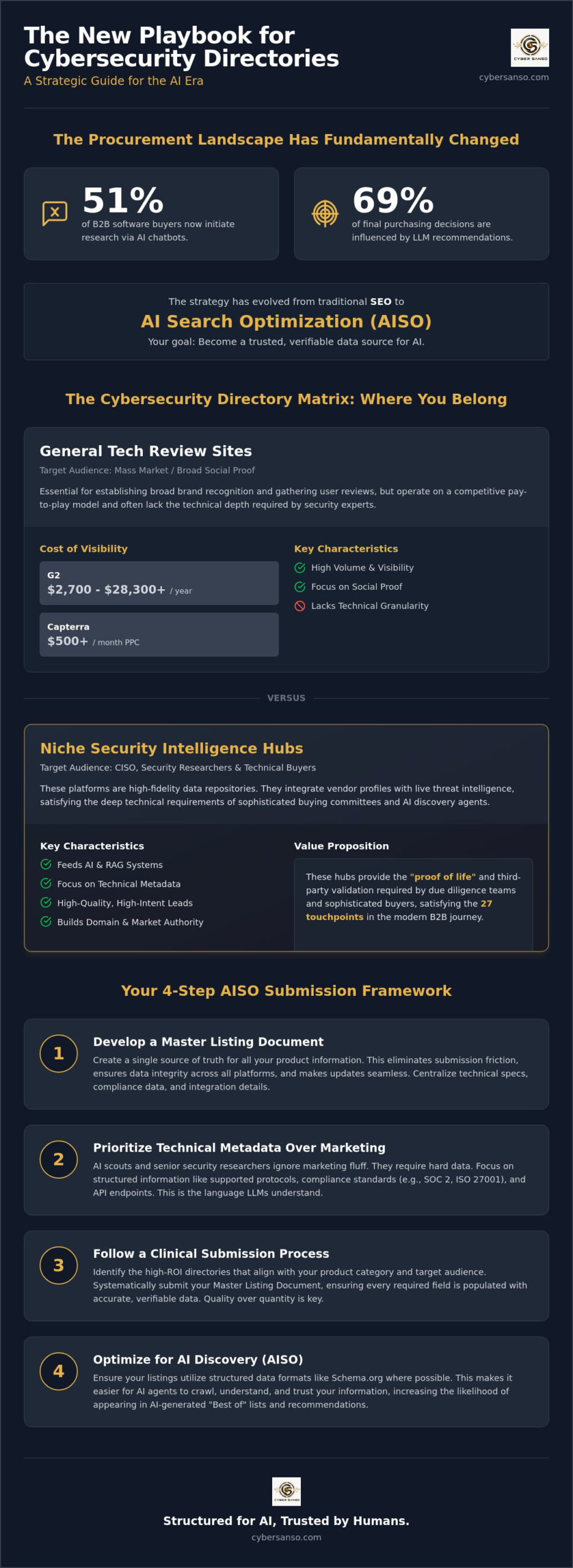
Recent data confirms that 51% of B2B software buyers now initiate their vendor research via AI chatbots; a shift that has fundamentally altered the procurement landscape. For vendors, the challenge is no longer just about appearing on a results page, it’s about becoming a verified data source for the LLMs that influence 69% of final purchasing decisions. If you want to get listed on cybersecurity directories in this environment, you need a strategy that prioritizes technical authority over simple volume. We understand the friction of navigating a crowded market where manual submission processes feel inefficient and the ROI of niche directories remains unclear.
This article provides a structured methodology to secure high-authority placements that drive lead generation and AI search visibility. You’ll learn how to identify reputable security domains and optimize your profiles to appear in “Best of” lists generated by autonomous discovery tools. We’ll move from broad directory selection to the granular optimization tactics required to capture the attention of technical decision-makers in 2026.
Key Takeaways
- Transition your strategy from traditional SEO to AI Search Optimization (AISO) to capture visibility within autonomous procurement systems.
- Follow a clinical submission framework to get listed on cybersecurity directories that offer the highest ROI for technical lead generation.
- Develop a Master Listing Document; it’s the most effective way to maintain data integrity and eliminate submission friction.
- Prioritize technical metadata over marketing language to satisfy the specific information requirements of senior security researchers.
- Utilize specialized intelligence hubs that synchronize vendor profiles with live vulnerability data for enhanced market authority.
The Strategic Value of Cybersecurity Directories in 2026
The modern cybersecurity directory is no longer a static list of vendors. It functions as a high-fidelity data repository that feeds both human procurement teams and autonomous AI agents. For organizations looking to get listed on cybersecurity directories, the objective has shifted from simple visibility to becoming a primary source for Retrieval-Augmented Generation (RAG) systems. While the traditional business directory served as a digital phone book, today’s security-specific hubs act as structured intelligence layers. They provide the technical depth required to satisfy the 27 touchpoints that the average B2B buyer now navigates before reaching a conversion decision.
When a Chief Information Security Officer (CISO) initiates a vendor search, they increasingly bypass the primary search engine result pages (SERPs) cluttered with sponsored advertisements and generic content. These decision-makers prioritize niche directories because they offer a curated, objective environment for comparison. This shift is driven by a need for efficiency. In a market saturated with “vaporware” and aggressive marketing, a directory listing provides a baseline of verified existence. It’s a clinical resource that strips away the fluff, allowing technical buyers to evaluate core capabilities, integration support, and compliance standards without the friction of a sales call.
The Shift from Human Search to AI Discovery
Large Language Models (LLMs) like ChatGPT and Perplexity don’t browse the web like humans; they ingest structured data to generate recommendations. If your company isn’t present in the datasets these models crawl, you don’t exist in the AI-generated shortlist. This transition from traditional SEO to AI Search Optimization (AISO) makes directory presence mandatory. AI “scouts” look for Schema.org markup and structured technical metadata to verify a vendor’s claims. By ensuring you get listed on cybersecurity directories that prioritize data integrity, you’re essentially providing a trust signal to the algorithms that now govern the top of the sales funnel.
Building Brand Authority and Trust
Trust is the primary currency in security procurement. A presence on an independent directory provides third-party validation that proprietary marketing materials cannot replicate. It establishes a digital paper trail essential for due diligence and risk management teams. Beyond the immediate lead generation, niche directory placements provide high-quality backlinks from security-focused domains. These links signal domain authority to search engines while providing the technical “proof of life” required by sophisticated buying committees. In 2026, a directory listing is an architectural necessity for any brand that values long-term market authority and transparent discovery.
The Cybersecurity Directory Matrix: Where Your Product Belongs
The cybersecurity vendor ecosystem is fragmented into four distinct quadrants. Each quadrant serves a specific stage of the procurement cycle and requires a unique engagement strategy. To successfully get listed on cybersecurity directories, a vendor must align their submission efforts with their target audience’s technical maturity. Mass-market platforms prioritize volume and social proof, while niche intelligence hubs focus on technical interoperability and threat context. Understanding this matrix is the first step toward efficient resource allocation.
General Tech Review Sites (G2, Capterra, Gartner)
Platforms like G2 and Capterra represent the “Mass Market” quadrant. These are essential for establishing broad social proof, but they operate on a transparent pay-to-play model. For instance, verified 2026 data shows Capterra typically requires a minimum monthly PPC budget of $500, while G2’s Starter tiers begin at approximately $2,700 annually and can reach $28,300 for Enterprise subscriptions. While these sites are highly visible, they often lack the technical granularity required by a security architect. They are generalist tools. If you want to list your company in business directories of this scale, prepare for a high volume of reviews that may prioritize user interface over cryptographic robustness.
Niche Security Intelligence Hubs (CyberSanso and Specialized Repositories)
Intelligence hubs cater specifically to the CISO and security researcher. Unlike generalist sites, these platforms integrate product listings with live security data, such as CyberSanso’s specialized vendor database and live CVE vulnerability trackers. This context is invaluable for technical decision-makers who need to see how a tool interacts with the broader threat landscape. These platforms offer the highest intent-to-buy traffic because the audience is already engaged in technical research rather than casual software browsing. Positioning your tool here allows it to be discovered within a technical ecosystem rather than a generic software list.
Community-Driven and Open-Source Lists
The final quadrant consists of community-curated repositories, such as “Awesome” lists on GitHub or dedicated security subreddits. These lists carry immense peer-to-peer authority but are resistant to traditional marketing. Engagement here requires a “contribution-first” mindset. You don’t buy your way onto these lists; you earn a spot through technical merit and community transparency. Maintaining visibility in these non-commercial repositories is a long-term play for brand credibility among practitioners.
Prioritizing these platforms depends on your operational capacity. Small teams should focus on niche hubs where technical accuracy outweighs review volume. Larger enterprises must maintain a presence across all four quadrants to satisfy the diverse stakeholders within a modern buying committee. Strategic placement ensures that when you get listed on cybersecurity directories, your product appears exactly where your specific buyer is performing their due diligence.
How to Get Listed and Approved: A Step-by-Step Submission Strategy
Securing a position within a high-authority repository requires a methodical approach similar to a technical deployment. Most vendors fail because they treat the process as a low-priority marketing task, resulting in high rejection rates from editors who prioritize data integrity. To successfully get listed on cybersecurity directories, you must first audit your existing digital footprint to ensure cross-platform consistency. Discrepancies in your company name, headquarters location, or core technical specifications act as red flags for both human curators and automated verification bots. It’s a tactical deployment that demands precision over speed.
Efficiency begins with a Master Listing Document. This centralized file should contain every technical detail an editor might request, from API availability to specific compliance frameworks like SOC2. By standardizing this data, you eliminate the friction of manual entry and prevent the introduction of conflicting information. When you identify the right contact person, typically a directory editor or community manager, your outreach should be clinical and utility-focused. A single, buzzword-free sentence defining your core Unique Selling Proposition (USP) is more effective than a multi-paragraph sales pitch. For example, “We provide real-time LLM prompt injection protection for enterprise RAG systems” is superior to “We offer the most innovative AI security solution on the market.”
Phase 1: Pre-Submission Preparation
Preparation involves gathering technical specifications that go beyond surface-level marketing. You must define your deployment models, such as SaaS, on-premise, or hybrid, and ensure your pricing transparency aligns with directory requirements. Selecting the correct sub-category is critical. Misclassifying an Endpoint Detection and Response (EDR) tool as Extended Detection and Response (XDR) can lead to immediate disqualification or poor lead quality. Prepare high-resolution brand assets and technical whitepapers that provide the “proof of concept” required for premium verification.
Phase 2: The Submission Process
The submission phase is where you must navigate the nuances of free versus premium tiers. When you get listed on cybersecurity directories, your descriptions must satisfy human researchers and AI crawlers simultaneously. Avoid the “Sales Pitch Trap.” Focus on specific problem-solving capabilities and technical integrations. If a directory doesn’t support structured metadata, use the description field to clearly list your technical stack and supported compliance standards to improve visibility in comparison filters.
Phase 3: Follow-up and Maintenance
A listing is a living asset, not a one-time transaction. Establish a schedule for quarterly audits to update product features, new integrations, and compliance status. Active maintenance includes responding to technical inquiries and user reviews on your public profiles. Tracking referral traffic and lead quality from specific directories allows you to refine your strategy. It ensures your resources are allocated to the platforms that generate the highest ROI for your technical decision-makers. It’s a continuous cycle of verification and optimization.
Optimizing Your Listing for LLMs and Technical Decision-Makers
Technical decision-makers operate on a logic of exclusion. When they scan a vendor profile, they’re looking for reasons to disqualify a solution that doesn’t meet specific architectural requirements. “Marketing fluff”-characterized by superlative claims like “revolutionary” or “next-generation”-is the primary reason senior researchers ignore a profile. To successfully get listed on cybersecurity directories and maintain engagement, you must replace adjectives with data. A clinical presentation of your technical stack, API availability, and supported compliance frameworks like SOC2 or ISO 27001 provides the transparency that CISOs demand during the initial vetting phase.
Entity association is the secondary layer of this optimization strategy. This involves linking your product listing to established technical benchmarks, such as specific CVEs your tool mitigates or the MITRE ATT&CK techniques it detects. LLMs establish brand authority by mapping the proximity of your company name to specific technical protocols, vulnerability identifiers, and architectural patterns found in structured datasets. By ensuring you get listed on cybersecurity directories that allow for granular metadata tagging, you’re essentially feeding the knowledge graphs that AI agents use to recommend vendors during a procurement query.
The CISO-Centric Content Framework
Your description should prioritize “Time to Value” (TTV) and “Ease of Deployment.” Technical buyers need to know if a tool requires a six-month professional services engagement or if it integrates via a simple OIDC connection. Use industry-standard terminology from the NIST Cybersecurity Framework to build instant credibility. Rather than a generic “Contact Us” button, provide direct links to your technical documentation or a self-service sandbox environment. This reduces friction and allows the buying committee to perform their due diligence without the interference of a sales representative.
Technical Metadata and AI Crawler Optimization
AI crawlers and RAG systems favor structured information over narrative prose. Use bulleted lists to define features, supported integrations, and hardware requirements; this structure significantly improves data extraction accuracy for LLMs. Your listing shouldn’t just point to your homepage. Instead, link to high-value technical pages, such as your API reference or security whitepapers, to satisfy “comparison” search intent. For organizations seeking to maximize this technical visibility, utilizing specialized vendor listing services ensures that your profile is architected specifically for high-intent AI discovery and human technical review.
Maximize Global Exposure with CyberSanso’s Vendor Listing Services
CyberSanso serves as a high-level intelligence platform rather than a static repository. While many organizations seek to get listed on cybersecurity directories to improve basic domain authority, CyberSanso provides a navigational hand through the technical complexities of the 2026 market. By integrating its Cybersecurity Vendor Database with a Live CVE Vulnerability Tracker, the platform ensures that vendor profiles are contextualized within the current threat landscape. This “Intelligence-First” approach allows vendors to be discovered not just by name, but by their functional relevance to specific, active vulnerabilities. It shifts the discovery process from a passive search to an active intelligence match.
Being positioned within this ecosystem places your solution alongside an LLM Comparison Hub and an AI Tools and SaaS Directory. This proximity is critical for modern B2B discovery. As discussed in previous sections, AI search agents prioritize entities that are associated with structured technical data. CyberSanso’s architecture is designed to facilitate this association, making it a primary destination for researchers who require validated insights rather than marketing narratives. It acts as a bridge between raw technical data and actionable professional intelligence. It’s a clinical environment where technical merit outweighs promotional spend.
Why CyberSanso is the Hub for Modern Security Pros
The platform’s Attack Types and Techniques Library attracts a high-intent audience of security researchers and architects. These professionals utilize the library to map defenses against specific adversary behaviors. When a vendor’s solution is linked to these technical categories, it captures the attention of decision-makers exactly when they are identifying a gap in their security stack. Additionally, the availability of free security utilities, checklists, and templates serves as a high-value entry point for technical buyers. These resources allow vendors to capture mid-funnel leads who are actively seeking operational guidance and ready-to-use templates for their internal audits.
Getting Started with CyberSanso Listing Services
The curated listing process is designed for precision and efficiency. Our Vendor Listing Services prioritize technical accuracy, ensuring that your profile includes the specific metadata LLMs and human buyers require. This includes API availability, compliance frameworks, and deployment models. By leveraging the platform, you establish a digital paper trail that supports the 27 touchpoints necessary for a modern conversion. It’s a strategic investment in transparency and brand authority. The goal is to provide a sense of order in a chaotic vendor environment, ensuring your product is seen as a reliable utility. Enhance your visibility in the CyberSanso Vendor Database today.
Securing Your Position in the 2026 Security Ecosystem
The transition from human-centric search to AI-driven discovery has redefined the requirements for vendor visibility. Success in this landscape depends on your ability to provide structured, technical data that satisfies both autonomous agents and senior security architects. The decision to get listed on cybersecurity directories is no longer just a marketing tactic; it’s a foundational step in establishing a verifiable digital footprint within the knowledge graphs that govern modern procurement. You’ve seen how technical metadata and clinical precision outperform traditional marketing fluff in the eyes of a CISO.
By prioritizing entity association and technical transparency, you ensure your solution is discoverable during the critical due diligence phase. CyberSanso provides the architectural framework necessary to achieve this level of authority. Our platform is trusted by security professionals for high-level technical intelligence and features a curated AI Tools & SaaS Directory integrated with a Live CVE Vulnerability Tracker. Taking control of your technical presence today ensures you remain a primary data source for the procurement cycles of tomorrow. List Your Security Tool on CyberSanso and establish your authority in a structured, intelligence-first environment. Your path to technical discovery starts with precise data.
Frequently Asked Questions
Are free cybersecurity directories worth the time for submission?
Free directories are valuable if they maintain high domain authority and industry-specific relevance. These platforms provide foundational citations that help AI models map your company as a verified entity within the security sector. Prioritize free listings on niche repositories and community-curated lists, as these often carry more weight with technical researchers than generic, paid tech catalogs.
How do directory listings impact my site’s SEO and domain authority?
Directory listings provide high-quality, niche-relevant backlinks that signal authority to search engine algorithms. Beyond simple link equity, these placements drive qualified referral traffic from technical decision-makers. Search engines interpret this high-intent traffic as a trust signal, which can improve your core domain’s ranking for competitive industry keywords over time.
Which cybersecurity directories do AI models like ChatGPT use for recommendations?
AI models prioritize structured data hubs that utilize Schema.org markup and provide detailed technical metadata. LLMs typically ingest data from high-authority review platforms, specialized security databases, and open-source repositories like GitHub. To influence AI recommendations, you must ensure your data is present on platforms that emphasize technical specifications over marketing prose.
How often should I update my vendor listings on external platforms?
You should conduct a comprehensive audit of your external profiles at least once per quarter. This frequency ensures that your technical specifications, such as new API integrations or updated compliance certifications like SOC2, remain accurate for procurement teams. Regular updates also signal to directory editors and AI crawlers that your product is actively maintained and relevant.
What is the difference between a software directory and an intelligence hub?
A software directory is a static catalog of products, whereas an intelligence hub integrates vendor data with live security metrics. Intelligence hubs connect listings with real-world context, such as live CVE trackers and attack libraries. This integration allows researchers to see how a tool functions within the current threat landscape, providing deeper utility than a simple feature list.
Can I get listed on cybersecurity directories without a dedicated marketing team?
Yes, any technical lead can manage the process if they utilize a Master Listing Document to standardize product data. The requirement to get listed on cybersecurity directories is primarily a task of technical accuracy rather than creative copywriting. Small, engineering-led teams can successfully secure placements by focusing on clinical descriptions and verifiable technical specifications.
How do I handle negative reviews on cybersecurity directory platforms?
Respond to negative feedback clinically by addressing the specific technical issue or clarifying product limitations. Avoid defensive language and focus on providing a roadmap for resolution or explaining the intended use case. Transparency regarding a tool’s capabilities builds significant credibility with technical buyers who prioritize honesty and technical realism over flawless marketing scores.
What specific technical information should I include in my vendor profile?
Prioritize deployment models, API availability, and supported identity providers like SAML or OIDC. It’s also essential to include data residency details and specific MITRE ATT&CK technique coverage when you get listed on cybersecurity directories. Providing this granular information allows technical decision-makers to perform an initial compatibility audit without needing to request a formal discovery call.