
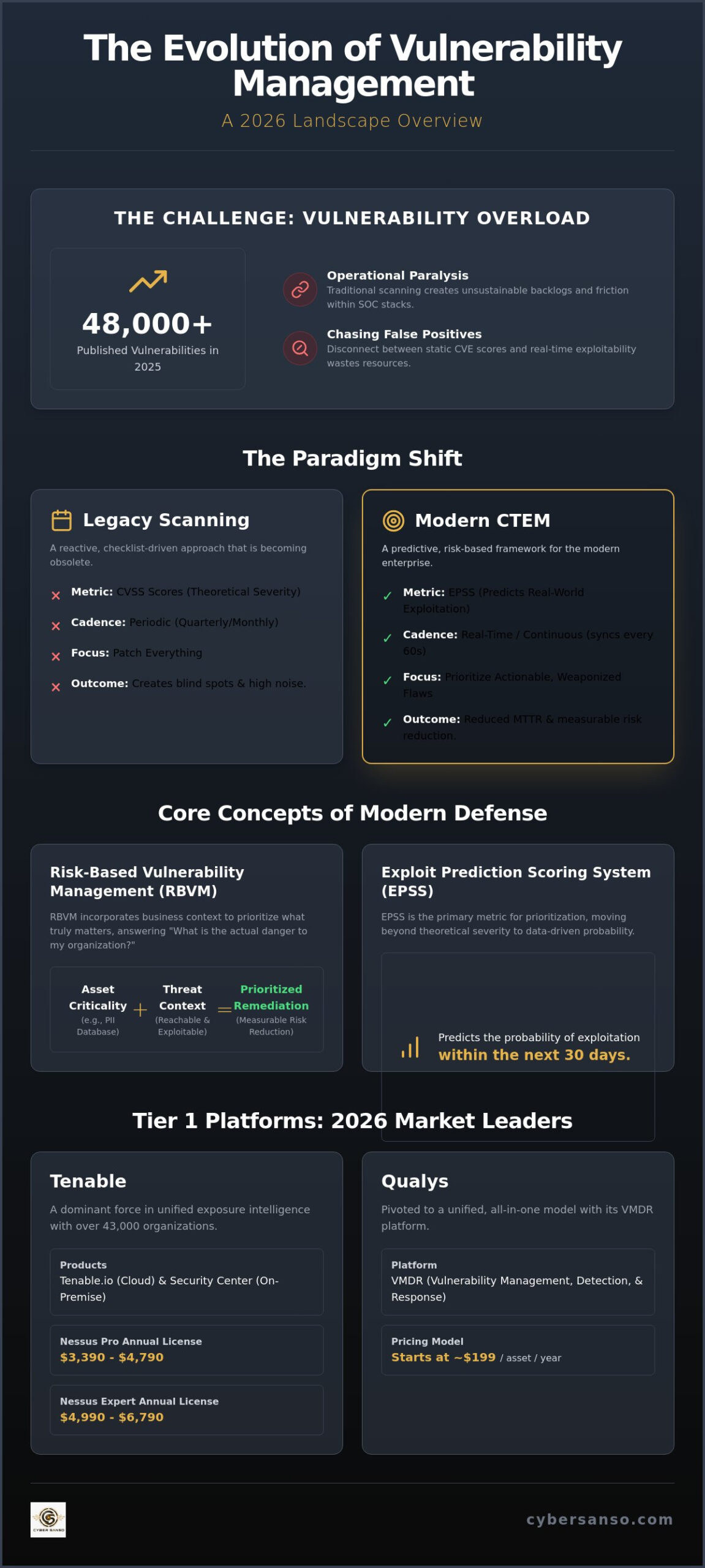
Published vulnerabilities surpassed 48,000 in 2025. This staggering volume has transformed traditional scanning from a security necessity into a source of operational paralysis. You’re likely dealing with the exhaustion of chasing false positives and the persistent disconnect between static CVE scores and real-time exploitability. When your security stack lacks cohesion, integration friction becomes a primary barrier to effective defense.
This guide offers a clinical, intelligence-driven breakdown of the market to help you refine your vulnerability management tools list for the 2026 landscape. We provide an objective analysis of leading enterprise solutions, moving beyond marketing claims to focus on verifiable performance and architectural fit. You’ll find a clear framework for distinguishing between legacy scan-based utilities and modern risk-based exposure platforms. This structured overview prioritizes a reduction in mean-time-to-remediate (MTTR) by aligning your tooling with the actual technical risks facing your hybrid-cloud environment.
Published vulnerabilities surpassed 48,000 in 2025, yet many organizations still rely on legacy scanning cadences that fail to address real-world exploitability. The overwhelming volume of false positives and the friction of integration within existing SOC stacks have made traditional scanning unsustainable. Refining your vulnerability management tools list for 2026 requires a decisive shift toward Continuous Threat Exposure Management (CTEM) and risk-based prioritization.
This article provides a definitive breakdown of the 2026 landscape, offering an objective evaluation of Tier 1 leaders and emerging AI-native platforms. You’ll gain a clinical selection framework focused on asset visibility and accuracy to help reduce your mean-time-to-remediate (MTTR). We also explore how leveraging live CVE trackers and vendor databases ensures your security posture remains resilient against the evolving threat vectors of the modern enterprise.
The Evolution of Vulnerability Management in 2026
The discipline of Vulnerability management has undergone a fundamental shift from reactive discovery to predictive orchestration. Organizations can no longer rely on a static vulnerability management tools list to secure environments that change by the second. The 2026 standard is Continuous Threat Exposure Management (CTEM). This framework prioritizes exposure based on the likelihood of exploitation rather than theoretical severity. It treats security as a dynamic process of exposure intelligence rather than a checklist of patches.
Traditional CVSS scores provide a baseline for technical severity, yet they lack the environmental intelligence required for modern risk modeling. The Exploit Prediction Scoring System (EPSS) has emerged as the primary metric for prioritization. It predicts the probability that a specific vulnerability will be exploited in the wild within the next 30 days. This shift allows security teams to ignore high-severity flaws that have zero exploitability. They focus instead on lower-severity bugs that are actively being weaponized by threat actors.
Managing the intersection of cloud-native assets and on-premise legacy infrastructure remains a critical challenge. Modern tools must bridge the gap between ephemeral serverless functions and decades-old mainframe systems. This requires a unified data model that can normalize telemetry from disparate sources into a single, actionable risk score. Efficiency in 2026 is defined by how quickly a team can move from discovery to verified remediation.
The Decline of Periodic Scanning
Quarterly or monthly scans create significant blind spots that attackers are eager to exploit. Modern threat actors weaponize new CVEs within hours of disclosure, making periodic reports obsolete before they’re even generated. Cloud assets are often ephemeral, existing only for minutes to handle specific compute loads. If your scanner isn’t active during that window, the asset remains invisible. In 2026, the baseline for security is a real-time asset discovery engine that synchronizes with cloud provider APIs and network telemetry every sixty seconds.
Risk-Based Vulnerability Management (RBVM)
Risk-Based Vulnerability Management (RBVM) bridges the gap between IT operations and security by incorporating business context. A critical bug on a guest Wi-Fi router is significantly less dangerous than a medium bug on a database holding customer PII. RBVM workflows prioritize remediation based on asset criticality and reachability. Security teams now utilize a real-time exploit database to verify if a vulnerability is actually reachable and exploitable before allocating precious engineering resources. This approach ensures that your vulnerability management tools list translates into measurable risk reduction rather than just a higher volume of closed tickets.
Tier 1 Vulnerability Management Platforms: The 2026 Market Leaders
The enterprise market continues to be anchored by a core group of providers that define the standard for a professional vulnerability management tools list. Tenable, Qualys, and Rapid7 remain the “Big Three,” though their architectural approaches have diverged significantly to meet 2026 requirements. Tenable remains a dominant force. With over 43,000 organizations utilizing its technology as of May 2026, the vendor has focused its recent efforts on unified exposure intelligence. The April 2026 release of Tenable Nessus version 10.12.0 introduced enhanced detection logic that specifically targets modern AI-driven attack vectors, reinforcing its position as a high-fidelity scanning engine.
Differentiating between Tenable.io and Tenable Security Center is now a matter of architectural philosophy. Tenable.io provides the elastic, cloud-native visibility required for dynamic environments, while Security Center offers the granular control necessary for complex, on-premise, or air-gapped infrastructure. Pricing for these professional utilities has stabilized; a Nessus Pro annual license currently costs between $3,390 and $4,790, while the Nessus Expert tier ranges from $4,990 to $6,790. These tools are no longer just scanners. They are central hubs for orchestrating a global security posture.
Qualys has pivoted toward a unified model with its VMDR (Vulnerability Management, Detection, and Response) platform. This solution integrates discovery, assessment, and automated patch management into a single interface. As of late 2025, Qualys VMDR pricing starts at approximately $199 per asset per year, positioning it as a premium, all-in-one alternative to fragmented security stacks. Meanwhile, Rapid7 InsightVM caters to organizations seeking agility through automation. Its tiered pricing, ranging from $2.19 per asset for 250 assets down to $1.93 for 500 assets, makes it a competitive choice for mid-market and enterprise teams alike.
Enterprise-Scale Powerhouses
Tenable’s Exposure View is a standout feature in 2026, utilizing sophisticated asset-linking capabilities to visualize how a single vulnerability might propagate across a hybrid network. Qualys maintains a technical advantage in its dual-mode architecture, allowing teams to toggle between lightweight agents for persistent monitoring and agentless side-scanning for rapid cloud assessment. These vendors are increasingly pressured by the rise of the cybersecurity competitive intelligence platform, which allows buyers to compare real-world performance data rather than relying on vendor-supplied whitepapers.
Integration and Ecosystem Compatibility
API maturity is the primary differentiator for Tier 1 tools in 2026. A tool’s value is often measured by its ability to feed high-fidelity data into SIEM and SOAR platforms without manual intervention. Leading Tier 1 platforms now maintain an average of 120 native integrations across security and ITSM categories to ensure seamless telemetry flow. Adherence to established frameworks, such as NIST Vulnerability Management, is simplified through pre-configured compliance reporting modules. For teams evaluating these market leaders against newer entrants, consulting a comprehensive vendor database provides the necessary transparency to avoid vendor lock-in and ensure long-term stack compatibility.
Emerging AI-Native and Cloud-Centric Vulnerability Tools
Modern infrastructure demands a departure from traditional, perimeter-focused security models. While the market leaders provide robust coverage for diverse environments, a new generation of AI-native tools has emerged to address the specific complexities of cloud-native architectures. These platforms often move beyond the standard vulnerability management tools list by integrating deeply with cloud APIs and container orchestration layers. They prioritize visibility into ephemeral assets that legacy scanners often overlook, ensuring that security keeps pace with rapid deployment cycles.
Wiz and Orca Security have redefined cloud security through agentless side-scanning. This technology allows for full-stack visibility without the operational overhead of installing and maintaining agents on every virtual machine or container. Wiz, for instance, utilizes a graph-based approach to map relationships between vulnerabilities, misconfigurations, and identity permissions. This creates a visual representation of potential attack paths. Estimated pricing for Wiz typically falls within the $24,000 to $38,000 range per year for approximately 100 cloud workloads, reflecting its position as a high-value enterprise solution.
SentinelOne Singularity Ranger offers another alternative by leveraging the existing EDR agent for “scanless” vulnerability management. This approach eliminates the need for resource-intensive network scans, providing real-time assessment of vulnerabilities as soon as the agent is active. By utilizing the same telemetry used for threat detection, this integration ensures that vulnerability data is always current and contextually relevant to the endpoint’s actual state.
Cloud-Native Application Protection Platforms (CNAPP)
CNAPPs are increasingly absorbing traditional vulnerability management functions within cloud environments. These platforms provide a holistic view of risk by combining vulnerability data with cloud infrastructure entitlement management (CIEM) and posture management (CSPM). The benefit lies in graph-based risk analysis. Instead of providing a flat list of 1,000 vulnerabilities, a CNAPP identifies the specific flaws that lie on a direct path to your sensitive data. This shift toward high-signal exposure intelligence is a hallmark of the 2026 security landscape.
Vulnerability Orchestration and Aggregation
As organizations adopt multiple specialized scanners, data silos become a significant operational burden. Nucleus Security and Brinqa have emerged as leaders in vulnerability orchestration. Nucleus acts as a central data normalization engine, ingesting telemetry from over 50 different security sources to provide a unified view of risk. Brinqa focuses on advanced risk modeling for complex, multi-tool environments, allowing teams to apply custom business logic to their prioritization workflows. To maximize the effectiveness of these platforms, organizations should consult a threat intelligence vendor list to ensure their orchestration engine is fed with the most accurate and timely exploit data available.
Critical Selection Framework: Evaluating Tools for Your Stack
Selecting a solution from a crowded vulnerability management tools list requires a move beyond surface-level feature comparisons. Successful evaluation depends on how a platform aligns with your specific operational architecture and risk tolerance. In 2026, the primary differentiator isn’t discovery, but the precision of the intelligence provided to your remediation teams. A tool that identifies 10,000 vulnerabilities without context is a liability; a tool that identifies the ten that actually matter is a strategic asset.
Asset visibility depth serves as the first critical metric. Your chosen platform must extend beyond traditional endpoints to identify shadow IT, unmanaged IoT devices, and ephemeral cloud microservices. If an asset exists on your network for only thirty minutes, your tool needs the telemetry to capture its state before it disappears. Accuracy remains the second pillar. High false-positive rates act as a hidden tax on your Security Operations Center (SOC), consuming hours of analyst time on non-existent threats. Prioritization logic should combine standard CVSS scores with real-time EPSS data and proprietary reachability analysis to ensure your team isn’t patching vulnerabilities that are inaccessible to attackers. Finally, remediation support must go beyond simple reporting. Integration with ITSM platforms like Jira or ServiceNow is mandatory for modern workflows, ensuring that security findings translate into actionable tickets for IT operations.
Platform consolidation is the most effective strategy for managing tool sprawl. While specialized scanners offer depth, a fragmented stack leads to data silos and inconsistent risk modeling. You should prioritize platforms that offer a unified data model, allowing you to view your entire exposure landscape through a single pane of glass. To ensure you’re making an informed decision, you can access our comprehensive cybersecurity vendor database to compare verified performance data across leading solutions.
Total Cost of Ownership (TCO) Analysis
Evaluating the TCO of a vulnerability management platform requires looking past the initial license fee. Implementation and ongoing maintenance labor often constitute the largest portion of the budget. SaaS deployments generally offer lower TCO by eliminating hardware maintenance, though they may carry higher long-term subscription costs. Conversely, on-premise solutions provide maximum data sovereignty but require significant internal engineering resources to manage. You must also calculate the “labor cost of inaccuracy.” If a tool’s high false-positive rate requires a full-time analyst just to filter results, that tool is significantly more expensive than a higher-priced, high-fidelity alternative.
The “False Positive” Litmus Test
A rigorous Proof of Concept (PoC) is essential for validating vendor claims regarding accuracy. This test should specifically target your most complex environments where legacy scanners typically struggle. Authenticated scanning, which uses credentials to log into assets, provides the highest level of precision and should be the benchmark for your evaluation. Unauthenticated results often lead to “potential” vulnerabilities that create unnecessary noise. To maintain consistency during your vendor trials, utilizing standardized security checklists and templates ensures that every tool is measured against the same technical requirements and business objectives.
Navigating the 2026 Vendor Landscape with CyberSanso
CyberSanso functions as a strategic advisor for organizations facing the complexity of the modern security market. While a standard vulnerability management tools list provides a starting point, it often lacks the real-time intelligence required for high-stakes decision-making. We provide a centralized knowledge hub designed to filter vast amounts of vendor data into actionable professional insights. This ensures that your selection process is driven by technical performance and architectural alignment rather than polished marketing narratives. Our role is to act as a steady hand, guiding you through an ecosystem where the cost of a wrong choice is operational paralysis.
Our Cybersecurity Vendor Database offers a granular view of market shifts, allowing procurement teams to track feature parity and pricing trends as they happen. This is complemented by our Live CVE Vulnerability Tracker. By monitoring emerging threats in real-time, security leaders can verify if their current or prospective tools possess the necessary detection logic for the latest exploits. It’s about maintaining a proactive posture that anticipates vulnerabilities before they’re weaponized. This intelligence-driven approach ensures that your vulnerability management tools list isn’t just a collection of logos, but a vetted stack of high-performance utilities.
Validation of scanner efficacy is another critical function of our platform. We offer an Attack Types and Techniques Library that allows you to map your tool’s capabilities against known adversary behaviors. If a scanner claims to cover specific lateral movement or credential harvesting techniques, you can use our library to verify those claims against documented attack patterns. This verification step is essential for ensuring that your defense-in-depth strategy has no invisible gaps. We believe that transparency is the only way to build a resilient security posture in a landscape where threats evolve daily.
Intelligence-Led Procurement
Procurement in 2026 requires a clinical approach to data analysis. CyberSanso filters through vendor hype by providing objective, independent evaluations of enterprise solutions. Our specialized listing services connect buyers with partners that fit their specific technical requirements and budget constraints. We also offer free security utilities that allow teams to supplement their primary platforms without incurring extra costs. This modular approach to stack building ensures you only pay for the high-value features your organization actually needs, reducing the financial burden of tool sprawl.
Continuous Monitoring of the Vendor Ecosystem
The security market is in a state of constant flux. We track M&A activity within the vulnerability management space to alert you to potential product end-of-life risks or sudden shifts in support quality. Staying updated with our Cybersecurity News & Insights ensures you’re never blindsided by a major vendor pivot or a new regulatory requirement. To begin refining your strategy with objective data, explore the CyberSanso Vendor Database and gain the oversight necessary to manage your modern exposure landscape.
Orchestrating Your Exposure Intelligence for 2026
The transition from periodic scanning to Continuous Threat Exposure Management (CTEM) is no longer a matter of preference; it’s a requirement for the modern enterprise. Navigating a vulnerability management tools list requires a clinical focus on asset visibility, prioritization logic, and integration maturity. Whether you’re leveraging the established power of Tier 1 platforms or the agility of AI-native cloud solutions, the goal remains the same: reducing risk through high-fidelity intelligence. Efficiency is found in the move from theoretical severity to verified exploitability.
Success in 2026 depends on your ability to filter vendor noise and focus on actionable data. By utilizing our Live CVE Vulnerability Tracker and Curated AI Tools & SaaS Directory, you can ensure your stack remains resilient against an ever-expanding threat landscape. CyberSanso provides the independent cybersecurity intelligence platform you need to make informed, data-driven procurement decisions. We act as your strategic partner in maintaining order within a complex technical environment.
Access the Comprehensive Cybersecurity Vendor Database to refine your strategy and secure your environment with confidence. You have the framework; now it’s time to execute.
Frequently Asked Questions
What are the top 5 vulnerability management tools for large enterprises in 2026?
Tenable, Qualys, Rapid7, Wiz, and SentinelOne represent the most robust options on any professional vulnerability management tools list. These platforms are selected for their ability to handle massive asset volumes and provide deep integration with modern SOC stacks. They offer a mix of agent-based, network-based, and cloud-native scanning capabilities to ensure full-spectrum visibility across complex, global infrastructures.
How do I choose between Tenable, Qualys, and Rapid7?
Your decision should be based on your primary architectural needs and existing security ecosystem. Tenable is often preferred for its scanning precision and the high-fidelity depth of its Nessus engine. Qualys provides a unified experience through its VMDR platform, which combines assessment with automated patching. Rapid7 is highly regarded for its automation features and ease of use in mid-market to enterprise environments that prioritize agility.
Can I replace a dedicated vulnerability scanner with an EDR-based solution?
EDR platforms like SentinelOne offer excellent “scanless” visibility for managed endpoints, but they don’t fully replace dedicated scanners. You still need traditional tools to assess network infrastructure, IoT devices, and unmanaged assets that lack security agents. Most mature organizations use a hybrid approach where EDR provides real-time endpoint data and dedicated scanners cover the remaining network gaps and legacy hardware.
What is the difference between vulnerability assessment and vulnerability management?
Vulnerability assessment is a point-in-time process focused on identifying and classifying security flaws. Vulnerability management is a broader, continuous lifecycle that includes discovery, prioritization based on risk, remediation orchestration, and ongoing monitoring. Management turns raw assessment data into a strategic program that reduces an organization’s overall attack surface over time by aligning security findings with business context and operational workflows.
How does AI improve vulnerability management tools in 2026?
AI in 2026 is primarily used to automate the prioritization of thousands of findings by analyzing real-world exploitability data. These systems correlate internal asset criticality with external threat intelligence to identify which vulnerabilities are actually reachable by attackers. This significantly reduces false positive fatigue and allows security teams to focus their limited resources on the small percentage of flaws that pose a genuine risk to the business.
What are the best free or open-source vulnerability management tools?
OpenVAS remains the most comprehensive open-source scanner for network vulnerabilities, while Nmap provides powerful discovery capabilities through its Scripting Engine (NSE). For application-specific testing, OWASP ZAP is the industry standard. While these tools are excellent for validation or smaller environments, they often lack the enterprise-grade reporting, API maturity, and orchestration features found in the paid platforms typically found on a commercial vulnerability management tools list.
How often should I run vulnerability scans in a hybrid cloud environment?
Modern hybrid environments require continuous, API-driven discovery rather than scheduled weekly or monthly scans. Cloud assets are often ephemeral and may exist for only minutes, making traditional scanning cadences ineffective. You should implement a system that triggers an assessment whenever a new asset is spun up or a significant configuration change is detected. This ensures your exposure data remains current despite the rapid pace of cloud deployments.
What is the most important metric for evaluating a VM tool?
Mean-Time-to-Remediate (MTTR) for exploitable vulnerabilities is the primary indicator of program health. A tool’s value isn’t measured by how many bugs it finds, but by how quickly it helps your team close the gaps that matter. You should also track the false positive rate, as high inaccuracy directly increases MTTR by wasting engineering resources on non-existent threats.