
The average U.S. data breach now costs over $10 million, yet many security leaders still rely on surface-level automation that fails under the pressure of a rigorous Type II audit. In 2026, the gap between marketing promises and actual auditor acceptance has widened significantly. This SOC2 compliance tool comparison moves past the polished sales decks to examine the technical architecture required for continuous, risk-based assessment. We recognize the friction caused by tool sprawl and the persistent fear that automation gaps might lead to a qualified opinion during your next reporting period.
This report delivers a clinical, research-driven analysis of the leading automation platforms to help you navigate the vendor landscape with objective authority. You’ll gain a vetted list of solutions categorized by specific organizational needs and a clear understanding of the technical differentiators that separate market leaders. We’ve synthesized the latest AICPA oversight changes and pricing shifts into a repeatable framework for your evaluation process. By the end of this guide, you’ll have the strategic intelligence necessary to select a partner that scales with your security stack without creating additional manual work.
Key Takeaways
- Analyze the shift from static GRC spreadsheets to agentic compliance platforms designed for the 2026 threat landscape.
- Apply a five-point clinical framework that prioritizes deep technical integration over the superficial volume of supported frameworks.
- Access a research-driven SOC2 compliance tool comparison of market leaders like Vanta, Drata, and Secureframe, segmented by organizational maturity.
- Pinpoint the “Automation Gap” to ensure your compliance posture accounts for controls that still require human judgment and manual evidence.
- Leverage independent intelligence tools, such as the CyberSanso Vendor Database, to vet the security and reliability of GRC vendors before selection.
The Evolution of SOC2 Compliance Tools in 2026
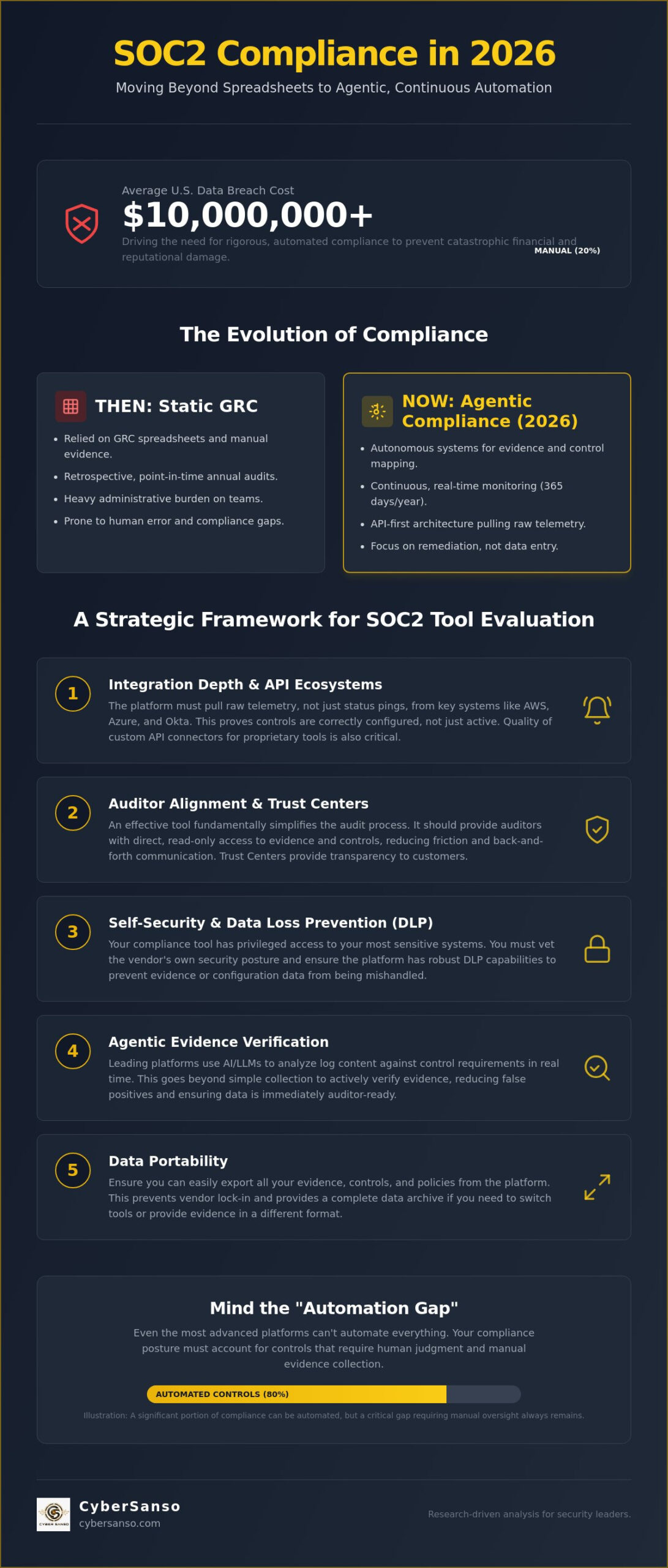
SOC2 compliance has transitioned from a static administrative burden to a dynamic data engineering requirement. In 2026, the complexity of hybrid cloud environments and the speed of vulnerability exploitation make manual GRC (Governance, Risk, and Compliance) spreadsheets technically insufficient. Modern organizations now utilize automated platforms to manage their System and Organization Controls (SOC) framework, shifting the focus from annual readiness to persistent operational health. This evolution is driven by a market that demands transparency over promises.
Traditional compliance methods relied on retrospective evidence collection. Today’s tools prioritize the five Trust Services Criteria: security, availability, processing integrity, confidentiality, and privacy. This SOC2 compliance tool comparison highlights how market leaders have pivoted toward “Agentic Compliance,” where autonomous systems perform the heavy lifting of evidence retrieval and control mapping. One-time readiness is a defunct concept for modern SaaS providers. A single day of misconfigured access can invalidate a year’s worth of trust, making real-time oversight the only viable strategy for maintaining market credibility.
From Point-in-Time Audits to Continuous Monitoring
The standard annual audit cycle is no longer the benchmark for enterprise trust. In 2026, evidence collection has moved from manual screenshotting to API-first architectures that pull real-time telemetry from your entire stack. These platforms conduct hourly automated testing of technical controls, ensuring that identity providers, cloud infrastructure, and version control systems remain compliant. This shift creates a state of “Audit-Ready” status 365 days a year. It allows security leaders to focus on remediation rather than administrative data entry, effectively turning compliance into a byproduct of good security hygiene.
The Rise of Agentic Compliance Platforms
Agentic compliance represents the next phase of automation. These platforms employ autonomous agents to map internal technical processes directly to specific SOC2 controls without human intervention. Large Language Models (LLMs) are now integrated into these systems to interpret dense policy documents and flag inconsistencies against actual engineering workflows. This significantly reduces the “compliance tax” on development teams. When evaluating these advanced features, security leaders often consult resources like the CyberSanso LLM Comparison Hub to verify the efficacy of the AI models powering these GRC tools, ensuring the automation is grounded in technical accuracy rather than marketing hype.
A Strategic Framework for SOC2 Tool Evaluation
Selecting a platform requires more than a feature-by-feature checklist. A clinical SOC2 compliance tool comparison must prioritize the technical integrity of the automation itself. Security leaders should utilize a five-point framework for assessment: Integration Depth, Auditor Alignment, Self-Security/DLP, Agentic Evidence Verification, and Data Portability. This structured approach ensures that the chosen tool acts as a strategic intelligence asset rather than a glorified task manager.
Integration Depth and API Ecosystems
Deep integrations with AWS, Azure, and Okta are non-negotiable for modern, distributed security stacks. Integration Depth is the ability to pull raw telemetry rather than just status pings. A status ping merely indicates a service is active; raw telemetry proves it is configured according to your specific security policies. For those still defining What is SOC 2 Compliance? in a technical sense, it is the persistent verification of these configurations. Evaluating the quality of custom API connectors is equally vital for proprietary internal tools that house sensitive data, as these often represent the largest gaps in automated evidence collection.
In 2026, the primary differentiator is how LLMs automate the verification of this evidence. Instead of just collecting a log, agentic platforms analyze the log’s contents against the specific control requirement in real time. This reduces false positives and ensures the evidence is immediately auditor-ready. Before committing to a vendor, use the LLM Comparison Hub to evaluate the underlying models of these compliance tools to ensure they meet your accuracy standards.
Auditor-Centric Features and Trust Centers
An effective platform must fundamentally simplify the auditor’s workflow. Features like a “Trust Center” allow you to share your real-time security posture with prospects, effectively turning compliance into a sales enablement tool. The “Audit Room” experience should facilitate seamless communication with external CPA firms, providing them with direct access to timestamped, immutable evidence. This transparency mitigates the friction typically found during the final weeks of a Type II audit.
Finally, assess the data security of the compliance tool itself. These platforms hold your most sensitive architectural data and policy documents; if the tool lacks robust DLP capabilities, your compliance posture is inherently compromised. Professionals often consult the CyberSanso Vendor Database to vet the security history and CVE records of these GRC providers before initiating a partnership. Avoid vendor lock-in by ensuring the platform allows for the export of all evidence and control mappings in standardized, machine-readable formats.
SOC2 Compliance Tool Comparison: Top Platforms by Segment
The market for compliance automation has matured into distinct tiers, each serving varying levels of technical complexity and organizational scale. This SOC2 compliance tool comparison categorizes vendors by their ability to handle everything from single-framework startup needs to multi-cloud enterprise posture (MCP). While the baseline goal remains the same, the technical execution varies significantly between platforms designed for high-velocity engineering teams and those built for legacy governance structures. Selecting a tool that doesn’t align with your infrastructure maturity often leads to “automation friction,” where the tool itself requires more manual maintenance than the audit it’s meant to simplify.
The Market Leaders: Vanta vs. Drata vs. Secureframe
Vanta is frequently cited as the gold standard for speed and ease of use, making it a primary choice for startups pursuing an initial SOC2 Type I. Its pricing for small teams typically starts between $10,000 and $12,000 annually. It’s highly effective for standard SaaS stacks but can feel restrictive for organizations with complex, non-standard architectures. Drata excels in multi-framework environments where automated control testing across hybrid stacks is a priority. It offers a more robust architecture for mid-sized companies, with annual costs ranging from $20,000 to $45,000, while enterprise deployments can exceed $60,000. Secureframe distinguishes itself with integrated security training and personnel management modules. Its entry point for very small startups is approximately $7,500, though enterprise multi-framework packages can scale beyond $130,000.
Specialized and Emerging Solutions
Beyond the market leaders, specialized platforms address specific vertical or geographic requirements. Sprinto has gained traction among tech-heavy startups in international markets due to its efficient mapping of technical controls across diverse regulatory landscapes. For organizations focused on long-term readiness and granular control mapping, Optro provides a sophisticated alternative to the broader platforms. Thoropass offers a unique hybrid model that bundles software with audit services, which can streamline the procurement process but may introduce concerns regarding independence for some stakeholders. High-velocity engineering teams are increasingly moving toward “Headless Compliance” tools that allow them to interact with the platform via CLI or API, keeping the compliance logic out of the way of the development lifecycle.
Selecting the right partner requires vetting beyond the feature list. Before committing to a multi-year contract, security leaders should consult the CyberSanso Vendor Database to check for recent security incidents or CVEs associated with these GRC tools. This intelligence layer ensures that your compliance partner doesn’t become a liability in your own supply chain security program. Understanding the technical differentiators between these segments is the first step in building a repeatable framework for vendor evaluation.
Addressing Common Implementation Pitfalls and Objections
Implementation of a compliance platform is often mistaken for a final destination rather than a technical enhancement. Any SOC2 compliance tool comparison must account for the psychological pitfall of over-reliance on automation. While these platforms excel at monitoring technical configurations, they cannot replace the governance required to manage a high-level security program. Security leaders must recognize that a tool is only as effective as the underlying policies it monitors. Automation without oversight creates a veneer of security that often collapses during the deep inquiry phase of a Type II audit.
This veneer is particularly dangerous when managing third-party risks. Conducting thorough SaaS vendor security assessments is a critical component of the SOC2 process that automation platforms often treat as a simple checkbox. In 2026, supply chain vulnerabilities remain a primary attack vector, requiring security teams to look beyond the “green light” of a dashboard. A strategic approach involves using these tools to aggregate data while maintaining an independent layer of verification for high-risk vendors.
The Myth of 100% Automated Compliance
Industry data suggests that approximately 20-30% of SOC2 controls remain outside the reach of pure automation. Controls related to strategic risk assessment, board-level oversight, and complex incident response post-mortems require qualitative human judgment. Automated platforms can flag a missing policy, but they cannot verify if the policy is actually understood or practiced by the workforce. Handling “Exceptions to the Rule” within these systems is a common friction point; auditors expect to see a documented rationale for why a specific control was bypassed, a task that still requires manual evidence and narrative context. Human oversight is essential to verify AI-remediated security gaps and ensure the platform’s logic aligns with actual business risks.
Managing DevOps Friction
Transitioning to a “Compliance-as-Code” model is essential for high-velocity teams, yet it often introduces significant DevOps friction. Integrating compliance checks directly into the CI/CD pipeline ensures that misconfigured infrastructure never reaches production. However, this must be balanced against “Alert Fatigue” caused by monitors that flag non-critical development environments with the same urgency as production. The Developer-Compliance Loop is defined as the time elapsed between a compliance violation being flagged and its remediation by the engineering team. To optimize this loop, many organizations utilize a cybersecurity competitive intelligence platform to benchmark their internal processes against industry standards and identify more efficient automation strategies.
Selecting Your SOC2 Partner via Strategic Intelligence
Selecting a partner for compliance is a high-stakes procurement decision that requires more than a review of marketing collateral. An effective SOC2 compliance tool comparison must extend into the vendor’s own security posture and technical reliability. In 2026, the GRC platform you choose becomes a central repository for your most sensitive architectural data. Consequently, vetting these vendors through a cybersecurity competitive intelligence platform is no longer optional; it is a fundamental requirement of modern supply chain risk management.
The transition from manual tracking to automated oversight is a significant architectural shift. It’s essential to choose a tool that aligns with your long-term security roadmap rather than one that merely satisfies an immediate audit deadline. A platform that lacks the flexibility to adapt to your specific cloud configurations will eventually become a bottleneck, forcing your engineering team into manual workarounds that defeat the purpose of automation. Objective intelligence is the only way to cut through the marketing hype and identify which platforms truly scale with enterprise complexity.
Leveraging the CyberSanso Intelligence Ecosystem
The decision-making process benefits from a layered intelligence approach. Many vendors claim “AI-driven” automation, but the efficacy of these models varies wildly across the industry. Professionals utilize the CyberSanso LLM Comparison Hub to evaluate the specific capabilities of the models powering these platforms. This ensures that the automation is capable of complex reasoning rather than simple pattern matching. Additionally, cross-referencing vendor listings with live CVE trackers is essential to identify historical or active vulnerabilities within the GRC software itself. Before committing to a specific software license, organizations often use CyberSanso security templates and checklists to bridge the gap and establish a baseline of readiness. This proactive mapping ensures that when you do implement a tool, the data ingestion is clean and the initial control mapping is technically accurate.
Final Selection Checklist for 2026
A clinical “Go/No-Go” decision should be based on three primary pillars: integration depth, auditor alignment, and technical scalability. Don’t settle for a platform that only offers status pings. Verify that the tool can pull raw telemetry from your specific cloud providers and identity management systems. A trial period is essential for testing these integrations in a sandbox environment. If the platform cannot ingest data from your proprietary internal tools without significant custom engineering, it’s a liability. Your final choice should align with your long-term security architecture. A tool that supports continuous monitoring today will prevent the “compliance debt” of tomorrow. To begin your due diligence, Search the CyberSanso Vendor Database to access independent intelligence on the market’s leading GRC providers.
Advancing Your Compliance Posture with Technical Authority
The transition toward agentic automation and continuous monitoring has fundamentally altered the security landscape. Success in today’s environment requires a shift from point-in-time readiness to a state of persistent operational health. This SOC2 compliance tool comparison has demonstrated that the most effective platforms are those that prioritize deep API integration and technical transparency over superficial feature lists. By addressing the “Automation Gap” and integrating compliance checks directly into your DevOps workflows, you can maintain audit readiness without compromising engineering velocity.
Strategic selection depends on independent intelligence rather than marketing claims. Before finalizing your vendor choice, it’s essential to verify their security history and technical efficacy. As an independent research platform, CyberSanso provides the data necessary to perform this due diligence with authority. You can access the CyberSanso Cybersecurity Vendor Database to explore a curated directory of over 2,000+ providers. Leverage our real-time CVE trackers and LLM comparison utilities to ensure your compliance partner is a secure and reliable asset for your long-term architecture. Building a foundation of trust starts with accurate intelligence.
Frequently Asked Questions
What is the average cost of SOC2 compliance software in 2026?
Annual licensing fees for compliance platforms vary based on organizational headcount and the number of frameworks supported. Small startups with under 50 employees typically pay between $7,500 and $12,000 for a single framework. Mid-market organizations can expect costs ranging from $20,000 to $55,000, while enterprise-level multi-framework deployments often exceed $100,000. These figures represent software costs only and don’t include separate fees for a licensed CPA firm to conduct the actual audit.
Can I achieve SOC2 Type II compliance using only automated tools?
No, automated tools are designed for readiness and evidence collection rather than the final attestation. An independent CPA firm must perform the audit and issue the official report. While a SOC2 compliance tool comparison often highlights high automation rates, approximately 20% to 30% of controls still require manual oversight. Human judgment remains essential for qualitative areas like strategic risk assessments and internal governance meetings.
How long does it take to implement a SOC2 compliance platform?
Technical integration of the platform typically requires two to four weeks. The timeline for full audit readiness depends on your existing infrastructure maturity. Startups might reach readiness for a Type I audit in 60 days, but a Type II audit requires a monitoring period of three to twelve months. This duration ensures the platform can collect sufficient evidence to prove that controls operated effectively over a continuous period.
What is the difference between GRC software and SOC2 automation tools?
GRC software provides a broad system for managing corporate governance, risk, and compliance across all business units. SOC2 automation tools are specialized platforms focused on technical evidence collection and real-time monitoring of security frameworks. Many modern platforms are converging into “Agentic Compliance” solutions that handle both broad policy management and granular technical telemetry through a single interface.
Do auditors accept automated evidence from AI-driven compliance platforms?
Yes, auditors accept automated evidence if the platform maintains an immutable audit trail. New AICPA Peer Review Board guidance effective June 1, 2026, has increased the oversight of how firms utilize these tools. Auditors will perform “re-performance” tests to verify that the platform’s AI accurately captures and interprets data from your production environment before accepting it as valid evidence.
How do SOC2 tools handle multi-cloud environments like AWS and Azure simultaneously?
Leading platforms utilize API-first architectures to aggregate telemetry from multiple cloud service providers into a centralized dashboard. This normalization process ensures that security policies are applied consistently across AWS, Azure, and Google Cloud. This capability is a primary factor in any SOC2 compliance tool comparison, as it prevents fragmented evidence collection in hybrid or multi-cloud infrastructures.
Is it possible to switch SOC2 vendors mid-audit cycle?
Switching vendors during an active audit cycle is possible but introduces significant operational friction. You must ensure that all evidence collected by the previous platform is exportable in a machine-readable format that your auditor can verify. Most organizations wait for the conclusion of an audit period to migrate to avoid potential gaps in their continuous monitoring history that could lead to a qualified opinion.
What are the security risks of giving a compliance tool full API access to my production environment?
Granting API access creates a supply chain risk, as the compliance platform becomes a high-value target for attackers. You should implement the principle of least privilege by using read-only API keys and scoping access to only the necessary metadata. It’s critical to vet the vendor’s own security history and encryption standards through an independent database before connecting them to your production stack.