Generative AI tools spread through organizations faster than almost any technology before them, often before IT and security teams even know they’re in use. Employees paste customer data into chatbots, marketing teams connect AI writing tools to shared drives, and developers wire AI coding assistants directly into production repositories, frequently without a formal review ever taking place.
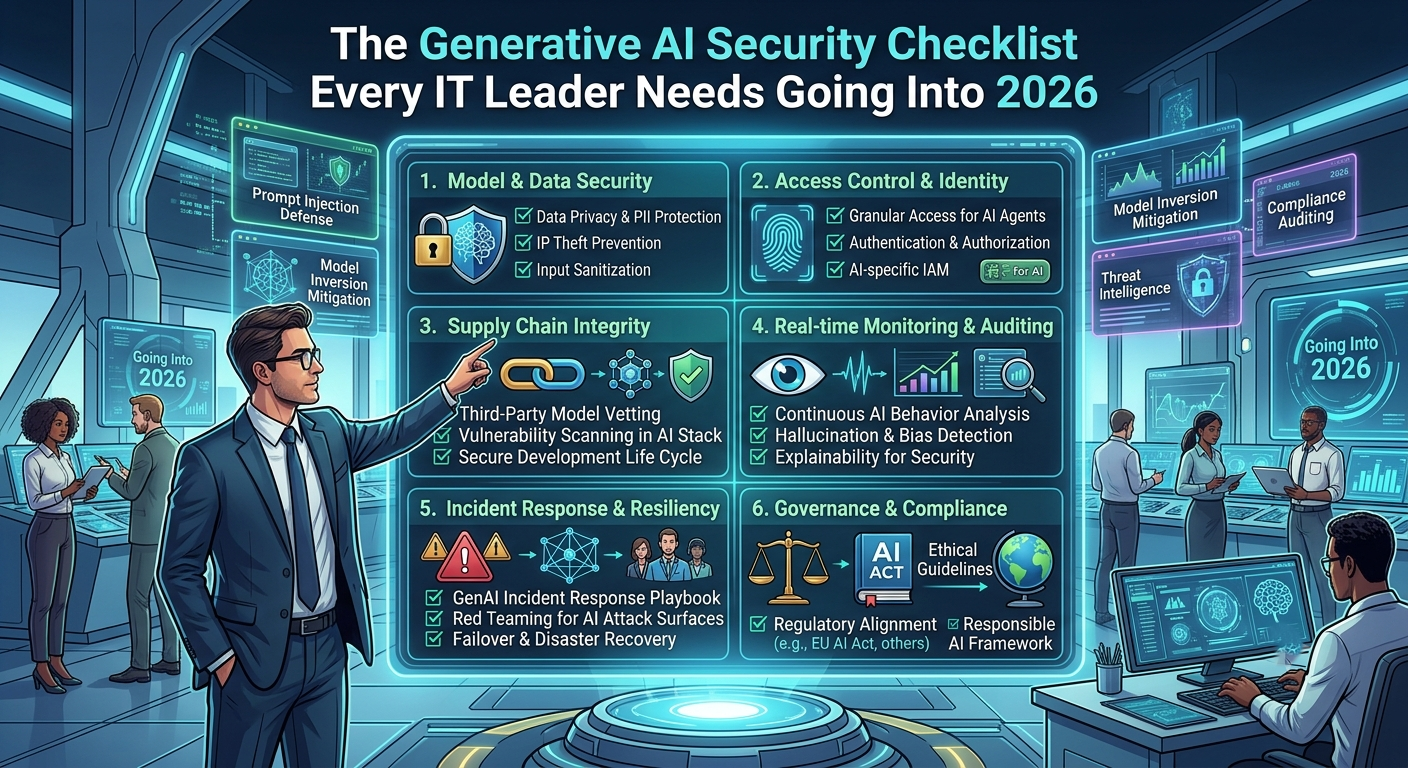
This generative AI security checklist gives IT leaders a structured way to catch up: covering data privacy, access control, shadow AI discovery, vendor risk, and compliance, so AI adoption can move forward without quietly expanding your organization’s attack surface in the process.
Table of Contents
- Why Generative AI Needs Its Own Security Checklist
- Data Privacy and Handling
- Access Control and Identity
- Discovering and Managing Shadow AI
- Vendor Risk Assessment for AI Tools
- Model and Output Governance
- Compliance and Regulatory Alignment
- Building This Into an Ongoing Program
- Finding Vetted AI Tools Through CyberSanso
Why Generative AI Needs Its Own Security Checklist
Traditional application security checklists were built around software that behaves predictably and stores data in known locations. Generative AI tools break both assumptions: outputs can vary between identical prompts, and many tools process, and sometimes retain, whatever data a user pastes in, regardless of how sensitive it is.
That combination of unpredictability and broad data exposure is why generative AI adoption deserves a dedicated review process rather than being folded into a generic SaaS security checklist. The risks aren’t hypothetical: multiple documented incidents in recent years involved employees inadvertently exposing proprietary source code or confidential business data through public AI chat tools.
The pace of adoption compounds the problem. Where a traditional enterprise software rollout might take months and involve procurement from the start, an employee can begin using a new AI tool the same afternoon they discover it, often with a personal account that never touches IT’s radar at all.
Data Privacy and Handling
Data privacy is almost always the first concern IT leaders raise, and for good reason: it’s the category most likely to produce an immediate, tangible incident rather than a slow-building compliance gap.
- Confirm whether each AI tool uses customer input to train future models by default, and whether that setting can be disabled at the account or enterprise tier.
- Classify what data categories, PII, source code, financial data, health information, are permitted to be shared with each approved tool.
- Verify data residency and retention policies match your compliance obligations, especially for regulated industries.
- Require encryption in transit and at rest for any AI tool that stores conversation history or uploaded files.
Access Control and Identity
- Enforce single sign-on (SSO) and multi-factor authentication for all approved enterprise AI tools and platforms, the same as any other critical business application.
- Apply role-based access so AI tools connected to internal systems only see the data a given user role actually needs.
- Review and periodically re-certify which employees and service accounts have API access to AI platforms.
- Disable or tightly scope plugin and connector permissions that let an AI tool read or write to other business systems.
Discovering and Managing Shadow AI
Shadow AI, tools employees adopt without IT approval, is often the single biggest blind spot in generative AI security. Discovery has to come before governance, since you cannot secure, or even meaningfully assess the risk of, a tool your organization doesn’t know is in use.
- Audit network and SaaS access logs for known AI tool domains and API traffic patterns.
- Survey department leads directly; many shadow AI tools are adopted openly within a team, just never reported upward.
- Publish a clear, easy-to-find list of approved AI tools so employees have a legitimate alternative to unsanctioned ones.
- Treat shadow AI discovery as ongoing, not a one-time audit, since new tools appear constantly.
Vendor Risk Assessment for AI Tools
Once a tool is identified, whether through formal procurement or a shadow AI audit, it needs the same structured risk assessment applied consistently, rather than an ad hoc review that varies by who happens to be evaluating it.
| Assessment Area | Key Question to Ask the Vendor |
|---|---|
| Data use | Is our data used to train models available to other customers? |
| Compliance | What certifications does the vendor hold (SOC 2, HIPAA-eligible, ISO 27001)? |
| Security testing | Does the vendor publish red-teaming or third-party security audit results? |
| Sub-processors | Which third parties, including model providers, does the vendor share data with? |
| Incident response | What is the vendor’s breach notification commitment and timeline? |
Model and Output Governance
Even a well-vetted AI tool needs guardrails around how its output gets used downstream. Governance here is less about the vendor and more about your own internal process for handling what the model produces.
- Require human review of AI-generated content before it’s used in customer-facing communications, legal documents, or code deployed to production.
- Document which business processes are allowed to use fully automated AI output without human review, and which are not.
- Monitor for prompt injection risk in any AI tool connected to external or user-submitted content.
- Establish a process for flagging and reporting AI outputs that appear inaccurate, biased, or inappropriate.
Compliance and Regulatory Alignment
Generative AI governance increasingly intersects with existing regulatory frameworks rather than existing in isolation. Align your checklist with the NIST AI Risk Management Framework for a structured governance baseline, and confirm industry-specific obligations, HIPAA for healthcare data, GLBA for financial services, are explicitly addressed in any AI vendor contract, not assumed by default. Regulatory guidance in this area is still evolving in many jurisdictions, which makes it worth revisiting your compliance mapping at least twice a year rather than treating it as settled.
Building This Into an Ongoing Program
A generative AI security checklist is a starting point, not a finished program. The tools, the vendors, and the regulatory landscape are all moving quickly enough that a one-time review will be outdated within a matter of months.
- Assign clear ownership of AI governance, typically a joint effort between security, legal, and IT.
- Re-run the vendor risk assessment at renewal and whenever a vendor materially changes its data policy.
- Keep the approved tool list current and communicate updates clearly across the organization.
- Revisit shadow AI discovery on a recurring schedule, not just once during initial rollout.
- Report AI adoption and risk posture to leadership on a regular cadence so governance stays visible, not an afterthought.
Finding Vetted AI Tools Through CyberSanso
CyberSanso’s AI Tools & SaaS directory profiles generative AI platforms with the security and compliance details IT leaders need for exactly this kind of checklist, data handling policy, certifications, and deployment options, in one place, so vendor risk assessment starts with real information instead of a blank page.
Key Takeaways
- Generative AI tools need a dedicated security checklist because they process data unpredictably and often retain it by default.
- Data privacy review should confirm training data use, data classification rules, and residency requirements for each tool.
- Shadow AI discovery must be ongoing, not a one-time audit, since employees adopt new tools continuously.
- Vendor risk assessment should cover data use, compliance certifications, sub-processors, and incident response commitments.
- Human review requirements should be explicitly defined for AI output used in customer-facing or high-stakes contexts.
- AI governance should align with established frameworks like the NIST AI Risk Management Framework, not be built from scratch.
Conclusion
Generative AI adoption isn’t slowing down, and trying to block it outright rarely works in practice; it just pushes usage further into the shadows where IT has even less visibility. A structured generative AI security checklist gives IT leaders a way to say yes to AI adoption responsibly, with clear guardrails around data privacy, access control, and vendor risk instead of an outright ban that employees quietly route around.
Treat this checklist as a living document. Revisit it as new tools emerge, as vendors update their data policies, and as regulatory guidance around AI continues to develop, so your governance program keeps pace with how quickly this technology is actually being adopted inside your organization. The organizations that get the most value from generative AI tend to be the ones that governed adoption early, rather than scrambling to retrofit security after the tools were already embedded in daily workflows.
FAQs
What is shadow AI, and why is it a security risk?
Shadow AI refers to generative AI tools employees adopt without formal IT approval. It’s a risk because sensitive data can be shared with unvetted tools that may have unclear data retention, training, or security practices.
Should companies block generative AI tools entirely for security reasons?
Outright bans often push usage underground rather than eliminating it. Most security leaders find a structured approval process, paired with clear approved-tool guidance, more effective than a blanket ban.
What compliance frameworks apply to generative AI use?
This depends on your industry, but the NIST AI Risk Management Framework provides a general governance baseline, while sector-specific rules like HIPAA or GLBA may add additional requirements depending on the data involved.
How often should an AI vendor risk assessment be updated?
At minimum, at contract renewal, and immediately whenever a vendor materially changes its data use, training, or sub-processor policies.
Do employees need training on generative AI security policies?
Yes. Clear, accessible guidance on which tools are approved and what data can be shared with them is one of the most effective ways to reduce shadow AI risk and accidental data exposure.
What is prompt injection, and should IT leaders worry about it?
Prompt injection is a technique where malicious instructions are hidden in content an AI model processes, potentially causing it to ignore its intended instructions. It’s a meaningful concern for any AI tool that processes external or user-submitted content.
Who should own generative AI governance within an organization?
Most mature programs treat it as a shared responsibility across security, legal, and IT, rather than assigning it to a single team, since the risks span data privacy, compliance, and technical security domains.